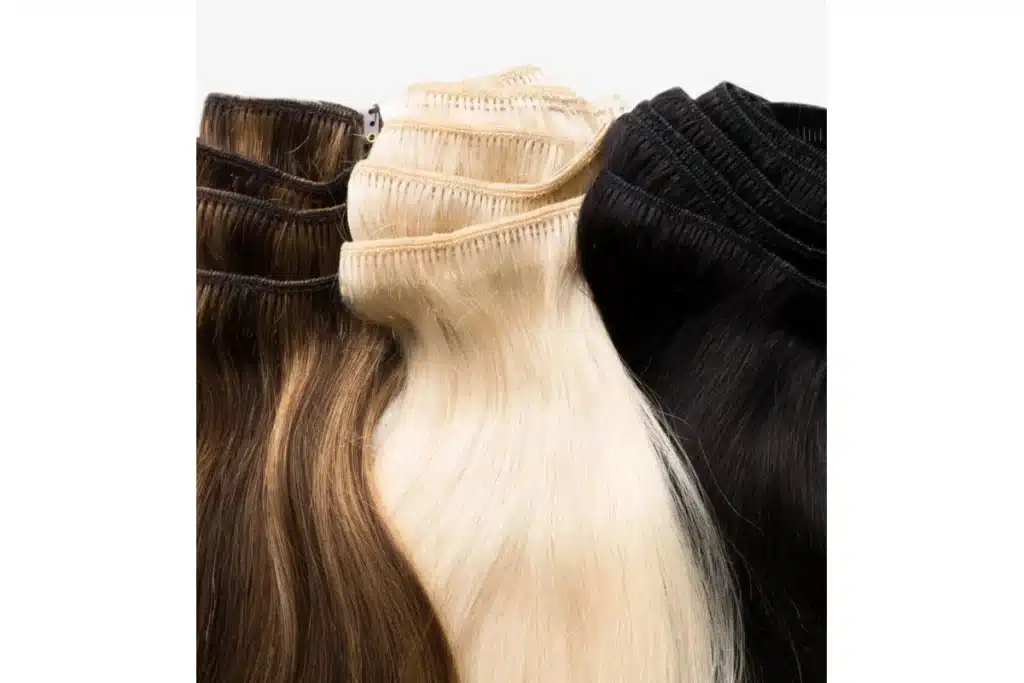
How many tape-in hair extensions do you need for a full head? Most full head installs need 40–60 tape pieces, which equals about 20–30 sandwiches.
Fine hair may need 30–40 pieces. Medium hair often needs 40–50 pieces. Thick hair or a fuller length transformation may need 60–80 pieces, depending on natural density, haircut, extension length, and the final look.
For salons, stylists, and hair brands, this is not only a pack-count question. The right quantity affects blending, comfort, installation time, maintenance, and client satisfaction.
This guide explains how many tape-in extensions are needed for a full head, how pieces, sandwiches, packs, and grams work, and what professional buyers should check before ordering.
| Client Hair Type | Suggested Pieces | Approx. Sandwiches | Best For |
|---|---|---|---|
| Fine or thin hair | 30–40 pieces | 15–20 sandwiches | Natural volume and light length |
| Medium hair | 40–50 pieces | 20–25 sandwiches | Standard full head result |
| Thick hair | 60–80 pieces | 30–40 sandwiches | Fuller blending and length |
| Volume only | 20–30 pieces | 10–15 sandwiches | Adding fullness without major length |

How Many Tape In Extensions Do You Need for a Full Head?
A full head does not mean the same number for every client. Fine hair, medium hair, and thick hair all need different planning.
For most clients, a full head of tape-in extensions needs 40–60 pieces. This usually equals 20–30 sandwiches, because one sandwich uses two tape pieces with natural hair placed between them.
Full Head Tape-In Quantity Guide
| Natural Hair Type | Pieces Needed | Sandwiches | Approx. Hair Weight |
|---|---|---|---|
| Fine / thin hair | 30–40 pieces | 15–20 sandwiches | 75–100g |
| Medium hair | 40–50 pieces | 20–25 sandwiches | 100–150g |
| Thick hair | 60–80 pieces | 30–40 sandwiches | 150–200g |
| Volume only | 20–30 pieces | 10–15 sandwiches | 50–75g |

These numbers are a practical starting point. The final amount still depends on the client’s haircut, head size, natural density, and desired result.For salons and hair brands sourcing this method, tape-in hair extensions should be checked by piece count, gram weight, tape size, adhesive stability, and after-wash softness.
A salon client once asked why 40 pieces looked full on one client but thin on another. The answer was simple: the first client had fine shoulder-length hair, while the second had thick blunt-cut hair and wanted 22 inches. The same number of pieces cannot create the same result on both heads.
How Do Pieces, Sandwiches, Packs, and Grams Work?
Many clients ask for packs, but salons usually think in pieces, sandwiches, and grams. These units need to be clear before ordering.
One tape sandwich usually uses two tape pieces. If a client needs 40 pieces, that means about 20 sandwiches. If one pack contains 20 pieces, that client may need about 2 packs. But pack size and grams vary by supplier.
Quick Unit Breakdown
| Unit | Meaning | Buyer Note |
|---|---|---|
| Piece | One single tape-in extension tab | Used to count individual tape tabs |
| Sandwich | Two tape pieces installed together | Common salon installation unit |
| Pack | Supplier packaging unit | May contain 10, 20, or 40 pieces |
| Grams | Total hair weight used for the install | Helps judge final fullness |
This is why I do not suggest judging a full head only by pack count. One supplier’s 20-piece pack may not have the same weight as another supplier’s 20-piece pack.
For salon owners and wholesale buyers, grams matter because they affect the final fullness. If the pieces are too light, the head may have enough tape tabs but still look thin through the ends. If the pieces are too heavy, the install can feel bulky or create too much tension.
How Do Length and Volume Goals Change the Quantity?
The longer the hair, the more important the ends become. A client choosing 16 inches may need fewer grams than a client choosing 22 or 24 inches.
Longer tape-in extensions usually need more pieces or more grams to keep the ends full. A 24-inch full head often needs more planning than an 18-inch full head, even if the client’s natural hair density is the same.
Quantity by Client Goal
| Client Goal | Suggested Pieces | Notes |
|---|---|---|
| Volume only | 20–30 pieces | Best for adding thickness, not major length |
| Natural full head | 40–50 pieces | Good for most medium-density clients |
| Length and full ends | 50–60 pieces | Better for longer extensions |
| Thick hair transformation | 60–80 pieces | Needed for dense natural hair or dramatic volume |
One common issue salon clients mention is this: the top blends well, but the ends look thin. This often happens when the piece count is enough for coverage, but the gram weight is not enough for the chosen length.
For example, 40 pieces may work well for 18 inches on medium hair. But if the client wants 24 inches with full ends, 40 pieces may not create enough density. In that case, the stylist may need more pieces, more grams, or a different placement plan.
How Many Packs of Tape In Extensions Do Salons Usually Need?
Pack count depends on how the supplier packages the hair. This is why “2 packs” or “3 packs” can be confusing without knowing how many pieces and grams are in each pack.
If one pack contains 20 pieces, most full head installs use 2–3 packs. Fine hair may need about 2 packs. Medium hair often needs 2–3 packs. Thick hair may need 3–4 packs or more.
Pack Estimate When One Pack Has 20 Pieces
| Hair Type | Pieces Needed | Packs Needed |
|---|---|---|
| Fine hair | 30–40 pieces | 2 packs |
| Medium hair | 40–50 pieces | 2–3 packs |
| Thick hair | 60–80 pieces | 3–4 packs |
| Volume only | 20–30 pieces | 1–2 packs |
This table only works if one pack contains 20 pieces. If the pack contains 10 pieces, the pack count will be different. If the hair is sold by grams, the calculation will also change.
For salons, I usually suggest keeping one extra pack available when doing full transformations. Running short during a service can affect blending, especially around the sides and ends.
For buyers comparing suppliers, it is better to ask three questions before ordering:
| Question | Why It Matters |
|---|---|
| How many pieces are in one pack? | Helps calculate full head quantity |
| How many grams are in one pack? | Helps judge real fullness |
| What is the tape size? | Affects comfort and placement |
| What is the hair weight per piece? | Helps compare suppliers correctly |
| Can the tape be replaced? | Important for reuse and maintenance |
What Affects the Final Full Head Result?
The final result is not decided by quantity alone. Two clients can use the same number of pieces and still get different results.
The final full head result depends on natural hair density, haircut, extension length, gram weight, tape placement, tape quality, and aftercare.
Main Factors to Check
| Factor | Why It Matters |
|---|---|
| Natural density | Thick hair needs more pieces to blend |
| Haircut | Blunt cuts need more density at the ends |
| Extension length | Longer hair usually needs more grams |
| Tape size | Affects comfort and placement |
| Hair quality | Affects softness after washing |
| Tape adhesive | Affects hold and reusability |
| Aftercare | Affects slipping and lifespan |
A blunt bob is often harder to blend than layered natural hair. If the natural ends are very thick, the stylist may need extra pieces around the sides and lower back to avoid a visible line.
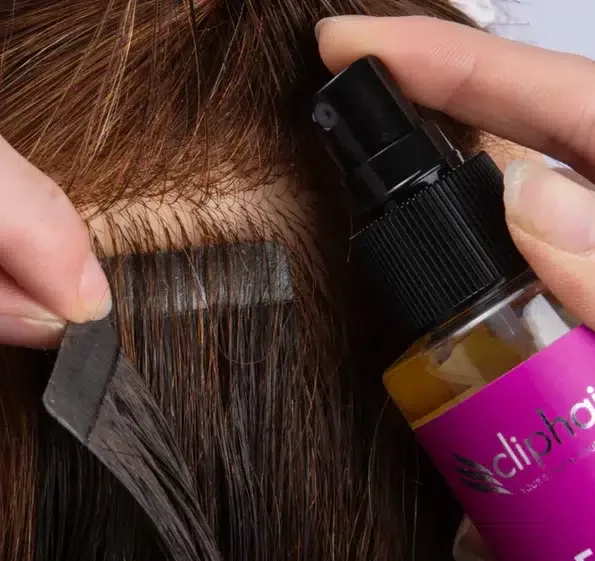
Tape quality also matters. If the adhesive is weak, the number of pieces will not solve slipping. If the hair becomes dry after washing, the install may look good on day one but disappoint the client later.For premium salons and hair brands, full cuticle hair is usually a better direction because the hair needs to stay smooth after washing, brushing, blow drying, and re-taping.
A full head install is not only judged on the first day. Clients also judge the hair after several weeks of wear.
My View
From a factory and export point of view, I do not think the best full head result comes from simply adding more tape pieces.
The better question is whether the pieces, grams, tape size, and client hair density match each other. More pieces can help with fullness, but too many pieces can also create weight, overlap, and maintenance pressure. A good full head should look full without feeling heavy.
Many salon and brand clients tell us that their real problem is not always “not enough hair.” Sometimes the problem is uneven fullness. The crown blends well, but the ends look weak. Sometimes the number of tape pieces is enough, but the hair weight is too light for longer lengths. Sometimes the hair feels soft in the sample, but the bulk order does not keep the same quality after washing.
This is why I pay close attention to tape hold, after-wash softness, color consistency, end fullness, and sample-to-bulk consistency. A salon does not only need one beautiful install. It needs a product that performs again and again for repeat clients.
For salon owners, hair brands, and wholesale buyers comparing suppliers, I suggest starting with samples before bulk orders. Test the hair after washing, brushing, blow drying, and re-taping.
You can review our wholesale tape-in hair extensions to compare tape types, colors, lengths, textures, and packaging options for salon or private label orders.
FAQs
How many tape-in extensions do I need for a full head?
Most full head tape-in installs need 40–60 pieces, or 20–30 sandwiches. Fine hair may need 30–40 pieces. Thick hair may need 60–80 pieces.
How many grams of tape-in extensions are needed for a full head?
Most full head installs use about 100–180g. Fine hair may need less, while thick hair or longer lengths may need 180–200g or more.
How many packs of tape-in extensions do salons usually use?
If one pack contains 20 pieces, most clients need 2–3 packs. Thick hair or dramatic volume may need 3–4 packs.
Do longer tape-in extensions need more pieces?
Usually yes. Longer extensions often need more grams or pieces to keep the ends full, especially for 22-inch and 24-inch results.
Is 40 pieces enough for a full head of tape-in extensions?
Forty pieces can be enough for fine or medium hair when the client wants natural volume. For thick hair, blunt cuts, or longer lengths, 40 pieces may look thin at the ends.
How many tape-in sandwiches are needed for a full head?
Most full head installs need 20–30 sandwiches. Fine hair may need 15–20 sandwiches, while thick hair may need 30–40 sandwiches.
Do grams matter more than pieces?
Both matter. Pieces help with placement and coverage, while grams decide how full the final result looks. A full head can still look thin if the total hair weight is too low.
Should salons order extra tape-in hair for full transformations?
Yes. For thick hair, long lengths, or blunt cuts, keeping one extra pack available is safer. Running short during installation can affect blending around the sides and ends.
Conclusion
Most full head tape-in installs need 40–60 pieces, or about 20–30 sandwiches.
Fine hair may need 30–40 pieces. Medium hair often needs 40–50 pieces. Thick hair, longer lengths, blunt cuts, or fuller transformations may need 60–80 pieces.
But quantity is only one part of the result. Stylists also need to check grams, tape size, placement, natural density, extension length, tape quality, and after-wash performance.
For salons and hair brands, the best full head result comes from balanced pieces, enough hair weight, stable adhesive, and consistent quality across repeat orders.
If you are sourcing tape-in hair extensions for salon services, wholesale orders, or private label products, you can contact Hibiscus Hair to request samples, wholesale pricing, or product recommendations.