Your client wants a darker tone, but the tape-ins are already installed. The color may seem easy to change, but the tape area makes the process risky.
You can dye high-quality human tape-in hair extensions darker, but you should avoid bleaching, avoid the tape tabs, and avoid dyeing too close to the root area. The mid-lengths and ends are much safer to color than the hair root near the tape.

Coloring tape-in extensions is different from coloring natural hair. Natural hair grows from the scalp, but tape-in extensions are attached with adhesive. Once dye, developer, conditioner, oil, or too much water reaches the tape area, the adhesive may weaken and the extensions may slip.
Can You Dye Tape-In Hair Extensions Safely?
Tape-in extensions can be dyed, but only under the right conditions. The hair quality, color direction, tape type, and application area all matter.
You can usually dye tape-in extensions darker if they are made from 100% human hair. But you should not bleach them lighter, and you should never let color touch the adhesive tape area.
When Dyeing Is Safer or Riskier
| Situation | Risk Level | Recommendation |
|---|---|---|
| Dyeing darker | Lower risk | Usually possible with strand testing |
| Toning slightly darker | Lower to medium risk | Keep toner away from tape |
| Dyeing mid-lengths and ends | Lower risk | Safer area to color |
| Dyeing near the tape root area | High risk | Avoid if possible |
| Bleaching lighter | Very high risk | Not recommended |
| Dye touching tape tabs | Very high risk | Can cause slipping |
| Dyeing synthetic hair | Very high risk | Do not dye |
| At-home box dye | High risk | Not recommended |
The safest color work is usually a darker tone on the mid-lengths and ends. The riskiest area is the upper part of the extension, close to the tape tab.
Many salon clients ask whether they can “just darken the roots” or “blend the top area.” This is where the risk starts. The hair near the tape is very hard to color cleanly because there is little working space. If the brush touches the tape, the adhesive may break down. If the color overlaps the tape edge, the extension may not stick well during the next installation.
can i dye my roots with tape in extensions?
The root area of tape-in extensions is difficult to dye because it sits too close to the adhesive. The stylist has very little space to apply color without touching the tape tab.
For most tape-in systems, the first section near the tape should be treated as a danger zone. It may look like normal hair, but it is attached to an adhesive strip. Any color work in this area needs very careful control.
Root Area vs Mid-Lengths and Ends
| Area | Dyeing Difficulty | Why |
|---|---|---|
| Near tape root area | Very difficult | Too close to adhesive |
| Top 1–2 cm below tape | High risk | Dye may bleed into tape |
| Mid-lengths | Easier | More space to apply color |
| Ends | Easiest | Far away from adhesive |
| Installed natural roots | Possible but risky | Must avoid tape overlap |
This is why I do not suggest treating tape-in extensions like loose natural hair. The top area is not easy to control. Even a small amount of dye, toner, developer, or conditioner near the tape can affect adhesion.
For regular tape-ins, the adhesive strip may loosen if color touches the tape. For invisible tape-ins, the risk can be even higher because the injected or PU root area is designed to mimic natural hair growth. If the top area is stained or over-processed, the natural root effect may be affected.
A salon client once asked why the extension hair took color well in the middle but the tape slipped after reinstallation. The problem was not the color itself. The color had touched the upper tape area during processing. The hair looked fine, but the adhesive performance had already been affected.
Can You Dye Invisible Tape-In Extensions?
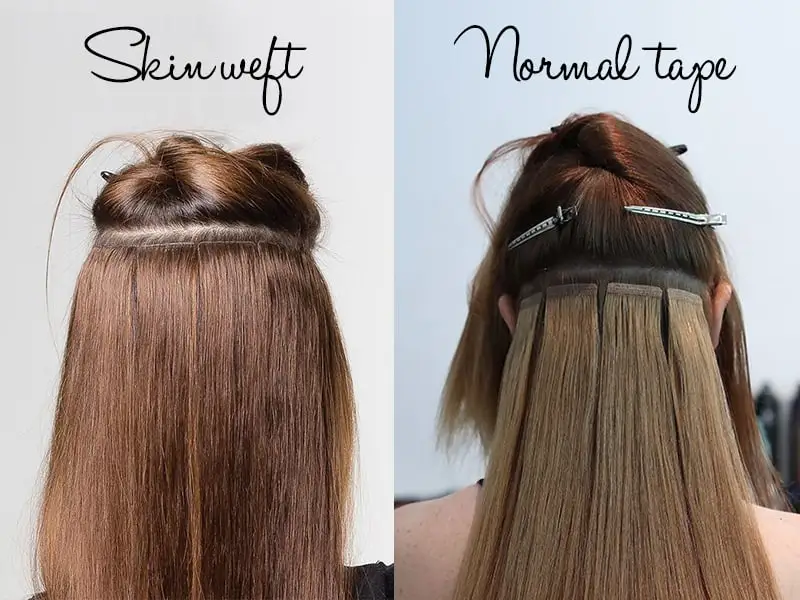
Invisible tape-ins need more caution than regular tape-ins. Their root area is more sensitive because the tape base is part of the invisible effect.
You can dye the mid-lengths and ends of invisible tape-in extensions if the hair is high-quality human hair. But you should avoid dyeing near the injected PU top area because it can stain the base, damage the root effect, or affect the adhesive.
Why Invisible Tape-Ins Are More Sensitive
Invisible tape-ins are designed to look like hair is growing from the scalp. The upper tape area often uses injection or special PU construction. This makes the root area look more natural, but it also makes color work more difficult.
| Area on Invisible Tape-In | Recommendation |
|---|---|
| Injected PU root area | Avoid dyeing |
| Tape adhesive zone | Never dye |
| Hair below the tape | Safer if protected |
| Mid-lengths | Usually safer |
| Ends | Safest area |
If a client wants a darker overall look, it is better to choose the correct color before installation. If the extensions are already installed, the stylist should avoid strong root color changes and focus on blending through the safer lengths.
Invisible tape-ins are beautiful when the color match is correct from the beginning. But they are not the best product to heavily recolor near the root. For salons and brands, this is why color selection before ordering is very important.
Can You Dye Tape-In Extensions While They Are Installed?
It is possible to dye tape-in extensions while they are installed, but it is not the safest option. The risk is much higher than dyeing loose extensions before installation.
If tape-ins are already installed, color should only be applied with careful control. The stylist must avoid the tape tabs, avoid heavy saturation near the roots, and focus on the mid-lengths and ends when possible.
Safer Zones When Tape-Ins Are Installed
| Zone | Recommendation |
|---|---|
| Natural roots between tapes | Possible with careful sectioning |
| Tape tabs | Avoid completely |
| Hair just below tape | High caution |
| Mid-lengths | Safer |
| Ends | Safest |
Root touch-ups are possible, but they are difficult. The stylist needs to color only the natural hair root area and avoid overlapping onto the tape tabs. This is not easy because the tapes sit close to the scalp and sectioning space is limited.
If the client wants a major color change, removing the extensions first is usually safer. It gives the stylist more control and protects the tape area. It also reduces the chance of uneven color, tape slippage, or patchy results.

Based on salon feedback, most coloring problems happen in three situations: the client tries to dye installed tape-ins at home, the dye touches the tape, or the stylist tries to lift the extensions lighter instead of only going darker.
How Should Tape-In Extensions Be Dyed?
Tape-in extensions should be dyed with a conservative approach. The goal is not only to get the right color. The goal is to protect the hair and keep the tape usable.
The safer method is to dye tape-in extensions before installation, use a darker color only, test a small strand first, protect the tape tabs, and apply color mainly to the mid-lengths and ends.
Professional Process Overview
| Step | What to Do | Why It Matters |
|---|---|---|
| Strand test | Test a small piece first | Checks color result and dryness |
| Check hair quality | Confirm it is human hair | Synthetic hair cannot be dyed normally |
| Protect tape tabs | Cover or avoid adhesive area | Prevents slipping |
| Apply color lower down | Focus on mid-lengths and ends | Keeps color away from tape |
| Process carefully | Follow professional timing | Avoids over-processing |
| Rinse downward | Keep water away from tape as much as possible | Reduces adhesive risk |
| Condition ends only | Avoid tape and root area | Protects adhesive |
A common mistake is applying dye too close to the tape because the stylist wants a perfect root blend. But tape-ins do not behave like natural hair roots. The closer the color gets to the adhesive, the higher the risk.
If the extensions need a soft color adjustment, it is better to work through the lengths. If the root color is very wrong, the better solution may be choosing a better-matched extension color, adding a rooted shade, or replacing the set instead of forcing color into the tape area.
Can You Bleach Tape-In Hair Extensions?
Bleaching tape-in extensions is not recommended. Even good human hair can become dry, rough, or weak after lifting.
Tape-in extensions should usually not be bleached lighter. Bleach can damage the cuticle, reduce softness, shorten the hair lifespan, and create a high risk around the tape area.
Why Bleaching Is Different From Dyeing Darker
Dyeing darker deposits color. Bleaching removes pigment. This makes bleaching much more aggressive.
Extension hair has already gone through cleaning, sorting, coloring, and production. Even full cuticle hair has limits. If it is bleached again, the hair may lose moisture faster and become harder to brush.
| Color Change | Recommendation |
|---|---|
| Darker brown | Usually possible with testing |
| Darker blonde tone | Possible with care |
| Light toning | Possible, but avoid tape |
| Lifting 1–2 levels | Risky |
| Bleaching to blonde | Not recommended |
| Correcting orange/brassy hair with strong chemicals | Risky |
For professional buyers, this is also a quality expectation issue. No supplier should promise that tape-in extensions can be bleached freely without risk. Even if the hair is good, repeated chemical processing will affect softness and lifespan.
Can You Dye Your Hair With Tape-Ins at Home?
At-home dyeing is possible in theory, but I do not suggest it for most clients. The risk is too high, especially when the extensions are installed.
Dyeing tape-in extensions at home can cause tape slippage, patchy color, dryness, tangling, and adhesive failure. It is safer to let a professional stylist handle any color work around installed tape-ins.
Common At-Home Problems
| Problem | What Can Happen |
|---|---|
| Dye touches tape | Adhesive weakens or slips |
| Box dye is too strong | Hair becomes dry or rough |
| Uneven saturation | Color looks patchy |
| Color overlaps roots | Tape becomes hard to reuse |
| Conditioner reaches tape | Extensions may slide |
| Poor rinsing | Residue causes stickiness |
Many clients think the main risk is only the final color. But with tape-ins, the bigger risk is often the adhesive. The hair may look darker and acceptable after dyeing, but the tape may not hold well afterward.
If a client insists on home color, the safest advice is to avoid the tape area completely, avoid bleach, avoid root coloring, and only make a mild darker adjustment on the mid-lengths and ends. Even then, there is still risk.
What Should Salons and Buyers Check Before Coloring Tape-Ins?
Before coloring tape-in extensions, salons and buyers should check hair quality, color history, tape structure, and whether the supplier allows post-coloring.
The most important checks are: whether the hair is human hair, whether it has been heavily processed, whether it can take darker color evenly, and whether the tape can stay protected during the process.
Pre-Color Checklist
| Checkpoint | Why It Matters |
|---|---|
| Hair material | Synthetic or mixed hair should not be dyed |
| Cuticle condition | Better hair handles color more evenly |
| Previous processing | Over-processed hair may dry quickly |
| Tape type | Invisible tape root areas are more sensitive |
| Target shade | Darker is safer than lighter |
| Strand test | Shows color result before full application |
| Supplier policy | Dyeing may affect warranty or quality claims |
A salon buyer once asked why one tape-in sample dyed evenly while another became dry after the same color process. In many cases, the answer is processing history. Hair that feels smooth because of coating may not hold up well after chemical color. Once the coating is stripped, dryness appears quickly.
That is why color testing should not only check whether the shade looks right. It should also check whether the hair still feels soft after washing, whether the ends stay smooth, and whether the tape area remains clean and usable.

My View
From a factory and export point of view, I treat coloring as both a quality test and a risk point.
Good tape-in hair should usually handle a darker color better than low-grade hair, especially when the cuticle is better protected and the hair has not been over-processed. But that does not mean every color change is safe. Dyeing always changes the hair condition. Bleach, strong developer, box dye, long processing time, and poor rinsing can damage even good hair.
Many salon clients tell us the real problem is not simply “Can tape-ins be dyed?” The real problem is where the color touches. If the dye stays on the mid-lengths and ends, the risk is more controllable. If the dye gets close to the tape, the situation changes. Adhesive failure, slipping, staining, and poor reinstallation can happen.
I also think root coloring with tape-ins needs to be explained more honestly. It is possible in some salon situations, but it is not easy. The stylist has very little working space near the tape. A small mistake can affect the adhesive. For invisible tape-ins, the upper PU area is even more sensitive because it is part of the natural scalp effect.
For salon owners and brand buyers, I usually suggest creating a simple color policy for clients. Explain that darker color on the lengths is usually safer, root-area coloring is high risk, bleaching is not recommended, and any color work may affect the product guarantee. Clear rules protect both the client result and the salon’s reputation.
For Buyers Comparing Tape-In Suppliers
For salon owners, hair extension brands, or wholesale buyers comparing tape-in suppliers, it is better to ask about hair quality, color processing history, tape hold, and whether the hair can support darker color testing.
You can review our Tape-In Hair Extensions page if you want to compare tape types, lengths, colors, and wholesale options.
FAQs
Can you dye tape-in hair extensions?
Yes, you can dye high-quality human tape-in extensions darker. You should not bleach them lighter, and you should avoid the tape area completely.
Can you dye the roots with tape-in extensions installed?
It is possible, but it is difficult and risky. The stylist must color only the natural root area and avoid overlapping onto the tape tabs.
Can you dye invisible tape-in extensions?
You can dye the mid-lengths and ends, but you should avoid the injected PU root area and tape adhesive area. These areas are easy to stain or damage.
What happens if dye touches the tape?
The adhesive may weaken, become sticky, slip, or fail during reinstallation. The extensions may need new tape or may not hold properly.
Can you bleach tape-in extensions?
Bleaching is not recommended. It can dry out the hair, damage the cuticle, shorten lifespan, and increase the risk of tape problems.
Conclusion
Tape-in extensions can be dyed darker when the hair quality is suitable and the tape area is protected. The safest color work is on the mid-lengths and ends, while root-area coloring and bleaching carry much higher risk.
References
[1] American Academy of Dermatology Association: How to Stop Damaging Your Hair ↩