Importing hand tied weft hair extensions from China can help your salon or brand scale faster, but it can also create costly quality problems if U move too fast. The key is not finding the cheapest supplier. The key is finding a manufacturer that can stay consistent as your order size grows.
To import hand tied weft hair extensions from China successfully, U should first screen manufacturers carefully, then test samples in stages, then scale orders gradually, and only move to full-volume cooperation after quality stays stable over time.
This process is not complicated, but it does require discipline. From a factory-side B2B angle, the real issue is not only whether a supplier can make a good sample. The real issue is whether they can repeat that quality across future bulk orders.
How Should U Screen a Hand Tied Weft Manufacturer?
The first mistake many buyers make is choosing too quickly. A nice catalog, a low MOQ, or a friendly salesperson does not tell U enough about real production ability.
U should screen a hand tied weft manufacturer by checking product knowledge, customization ability, quality control logic, communication quality, and whether the factory’s positioning matches your own brand level.
Start With Research, but Do Not Stop There
Online search is useful, but it is only the first step. U should also compare:
- website clarity
- product detail quality
- communication speed
- how clearly they explain raw hair, construction, and quality control

Ask Better Questions
A serious supplier should be able to explain:
- where the raw hair comes from
- how the hair is processed
- how hand tied wefts are constructed
- how shedding, tangling, and color fastness are controlled
- what customization is realistic
Check Positioning Match
Not every supplier fits a premium salon or brand. Some factories are built for low-cost volume. Some are better for higher-end buyers who care about softness, consistency, and repeat performance.
| What to Check | Why It Matters |
|---|---|
| Product knowledge | Shows real expertise |
| Communication quality | Shows future service reliability |
| Customization ability | Affects brand fit |
| Quality control logic | Affects order stability |
| Factory positioning | Affects long-term cooperation |
From a factory-side view, this step is really about filtering out suppliers who can talk well but cannot support premium repeat business.

Why Are Samples Only the Beginning?
A sample is necessary, but it is not proof of long-term reliability. Many buyers over-trust one nice sample.
Samples are useful for first evaluation, but they are only the first checkpoint. U still need staged testing before U can trust a supplier with serious order volume.
Test More Than Appearance
The hair may look beautiful at first, but premium buyers need more than first impression. U should test:
- softness
- strength
- tangling
- shedding
- color fastness
- wear performance
Test Under Real Use Conditions
A useful test is not just looking at the weft in the package. U should check how it behaves in:
- brushing
- washing
- daily wear
- styling
- light dyeing if relevant
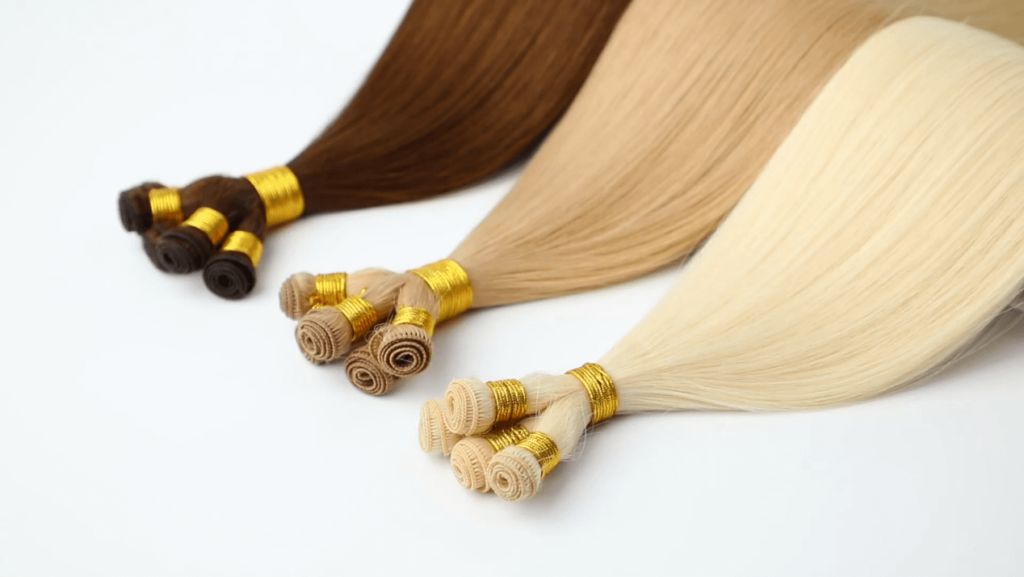
Watch the Weft Construction
Hand tied wefts need careful checking because the tying quality directly affects shedding and long-term durability.
| Test Area | What U Want to See |
|---|---|
| Softness | No harsh processed feel |
| Durability | Hair does not weaken too quickly |
| Tangle resistance | Smooth daily wear performance |
| Shedding | Secure tying structure |
| Color fastness | Stable tone after washing |
A premium buyer should never treat testing as a one-time box to check. Testing is how U reduce future complaints before they become expensive.
What Is the Right Way to Scale From Samples to Bulk Orders?
This is the stage where many importers make their most expensive mistake. They like the samples, then jump straight into a large order.
The safer way is to grow volume in phases. U should move from initial evaluation, to practical use testing, to small market testing, and only then to formal larger orders.
Phase 1: Initial Evaluation
Start with a very small number of samples.
This stage is for checking:
- appearance
- feel
- texture
- basic construction
- whether the product direction is even worth continuing
Phase 2: Practical Use and Full Testing
Then move into broader testing with more pieces.
This stage should include:
- actual salon use
- washing
- brushing
- styling
- daily wear observation
Phase 3: Small Market Testing
Once U feel confident, test a small batch with real customers or stylists. This is where U learn whether the product still performs well outside your own controlled checking.
Phase 4: Controlled Growth
Only after stable results should U begin increasing order size gradually.
| Phase | Main Goal |
|---|---|
| Initial samples | Basic product judgment |
| Practical testing | Real performance checking |
| Small market batch | Outside feedback validation |
| Controlled bulk growth | Lower-risk scaling |
This staged approach may look slow, but it is much cheaper than correcting a large failed order later.

When Should U Move to Formal Long-Term Orders?
A formal order relationship should come after proof, not before it.
U should move to formal long-term orders only after the supplier has shown stable quality across multiple test stages, not just after one successful sample round.
Stability Matters More Than Speed
The real target is not “place bulk quickly.” The real target is “build a supplier relationship that can hold your quality level over time.”
Keep Monitoring Even After Growth Starts
Even after U begin larger orders, U should still:
- spot-check batches
- compare new shipments against approved standards
- keep records of defects or changes
- collect stylist and customer feedback
Move All Orders Only After Long-Term Proof
Do not transfer all buying volume to a new supplier too early. A supplier becomes reliable only after they prove consistency over time.
| Decision Point | Better Rule |
|---|---|
| One good sample set | Not enough |
| One small good batch | Still not enough |
| Repeated stable performance | Stronger signal |
| Long-term consistency | Real basis for full transfer |
This is where disciplined buyers outperform impulsive buyers.

How Should U Protect Quality After Orders Increase?
A lot of buyers focus heavily on supplier selection, then become too relaxed once ordering starts. That is risky.
Quality control should continue after U scale. Growing order volume without growing quality monitoring is one of the most common import mistakes.
Use Scheduled Checks
Set fixed checkpoints for:
- new order review
- batch inspection
- random testing
- complaint tracking
Keep a Feedback Loop
Stylists and end users will often detect quality changes before the buyer sees them in the warehouse. Their feedback should go back into your supplier evaluation.
Compare Batches, Not Just Individual Pieces
A supplier may still send acceptable hair, but the texture, thickness, or tying may shift slightly across orders. That is where batch comparison matters.
| Ongoing Control Tool | Purpose |
|---|---|
| Batch spot checks | Catch consistency shifts |
| Stylist feedback | Detect real-use problems |
| Complaint logging | Track supplier patterns |
| Reorder comparison | Protect brand standard |
For premium brands, this is not optional. This is part of the business model.

How Should U Handle Pricing and MOQ Negotiation?
Many buyers negotiate price too early and too aggressively. That often attracts the wrong kind of supplier behavior.
Price and MOQ should be negotiated after product fit is clear. In premium hand tied wefts, the better goal is not lowest price, but stable value at workable volume.
First Confirm Quality Level
If U negotiate hard before quality is proven, the supplier may simply reduce the standard in hidden ways.
Use Volume Gradually
Once the product is stable, U can discuss:
- tiered pricing
- volume discounts
- better payment terms
- clearer long-term forecasts
Think in Total Value, Not Unit Price Alone
A slightly higher unit cost may still be cheaper if the product:
- tangles less
- sheds less
- lasts longer
- causes fewer complaints
| Pricing Logic | Better View |
|---|---|
| Lowest unit price | Short-term thinking |
| Stable premium quality | Better long-term value |
| Volume-based negotiation | Smarter after validation |
| Flexible payment discussion | Useful after trust builds |
This is how serious B2B buyers protect both margin and reputation.
What Logistics Points Should U Watch Closely?
Good hair can still become a stressful project if the shipping and arrival process is weak.
U should plan logistics around speed, customs readiness, arrival checks, and how quickly any discrepancies can be documented and addressed.
Choose Freight Based on Product Value and Urgency
Hand tied wefts are lightweight and high value, so air freight is often practical. But the best choice still depends on your timing and margin structure.
Prepare for Customs Before Shipping
Know your local:
- duties
- taxes
- paperwork requirements
- product declaration needs
Inspect Again After Arrival
Do not assume the job is done once the boxes arrive. Perform:
- spot checks
- construction checks
- softness checks
- color checks
- discrepancy records
| Logistics Step | Why It Matters |
|---|---|
| Freight planning | Controls timing and cost |
| Customs preparation | Prevents delays |
| Arrival inspection | Protects quality confirmation |
| Discrepancy recordkeeping | Supports claims and correction |
A professional import process ends only after the arrival quality is confirmed.

My View
From a factory-side B2B angle, importing wholesale hand tied weft hair extensions from China is not about finding one attractive sample. It is about building a controlled path from supplier screening to repeatable bulk quality.

The strongest buyers do three things well:
- they filter suppliers carefully
- they test in stages
- they scale slowly and monitor continuously
That is what protects a premium salon or brand. Not speed. Not cheap price. Not supplier promises alone.

Conclusion
If U want to import hand tied weft hair extensions from China successfully, the safest path is careful supplier screening, staged testing, gradual order growth, and ongoing quality control. That is how U turn one good sample into a reliable supply relationship.