Last Updated: 2026 | Reviewed by Hibiscus Hair Technical Team
Choosing the right hair extension method is one of the most critical decisions for salon owners, stylists, and end-users. With modern advancements like Genius Wefts and V-Light curing technology, matching the right extension system to natural hair density, client lifestyle, and maintenance capability directly impacts client satisfaction and salon retention.
This complete guide breaks down the 8 main types of hair extension methods, comparing application techniques, wear time, tension levels, and ideal client fit—plus key factory quality standards to look for when sourcing hair.
Quick Navigation for B2B Sourcing:
If you are a salon owner or hair brand buyer looking for wholesale specs, jump directly to our Factory Sourcing & Quality Guide.
Fast Comparison Matrix: 8 Extension Methods at a Glance
| Extension Method | Installation Time | Wear / Move-Up Time | Scalp Tension | Ideal Hair Density | Main Advantage |
|---|---|---|---|---|---|
| Clip-In | 5–15 mins | Daily Removal | Very Low | All Densities | Instant DIY transformation |
| Halo | 2–5 mins | Daily Removal | None | Fragile / Fine | Zero root attachment |
| Tape-In | 30–60 mins | Move-up: 6–8 weeks | Low–Medium | Fine to Medium | Lies ultra-flat, fast application |
| Weft (Genius/Hand-Tied) | 60–120 mins | Move-up: 6–8 weeks | Medium | Medium to Thick | Full coverage, high volume |
| Keratin Bond (Hot Fusion) | 2–4 hours | 3–4 months | Medium | Fine to Medium | 360° natural movement |
| I-Tip (Cold Fusion) | 2–3 hours | Move-up: 6–8 weeks | Medium | Medium to Thick | Heat-free, reusable strands |
| Nano Ring | 2–3 hours | Move-up: 6–8 weeks | Low–Medium | Fine to Medium | 90% smaller than micro beads |
| V-Light Curing | 30–60 mins | 6–8 weeks | Very Low | Ultra-Fine / Crown | 100% invisible targeted placement |
Detailed Breakdown: 8 Types of Hair Extensions
1. Clip-In Hair Extensions (Temporary)
Clip-ins feature horizontal fabric or silicone wefts equipped with pressure-sensitive clips. They are applied and removed daily by the user without professional tools.
- Best For: Event styling, brides, temporary volume, and beginners.
- Wear Time: Daily removal (1-day wear).
- Install Time: 5–15 minutes.
- Stylist Tip: Ideal retail addon product for salons to boost revenue without taking up appointment chair time.
2. Halo Hair Extensions (Temporary)
Halo extensions utilize a single continuous weft secured by an adjustable, transparent nylon wire that sits around the crown, naturally hidden under the top layer of natural hair.
- Best For: Fragile, compromised hair, scalp sensitivity, and zero-maintenance clients.
- Wear Time: Daily removal.
- Install Time: 2–5 minutes.
- Key Advantage: No clips, beads, or glue touch the scalp or roots, eliminating mechanical damage.
3. Tape-In Hair Extensions (Semi-Permanent)
Tape-in extensions use thin, medical-grade adhesive tabs that sandwich small horizontal sections of natural hair.
- Best For: Fine-to-medium hair, seamless blending, fast salon installation.
- Wear Time: 6–8 weeks before tape replacement and move-up.
- Install Time: 30–60 minutes.
- Stylist Watchout: Keep clarify-shampooing strict prior to install; avoid applying heavy oils or silicones near the tab roots to prevent slippage.
4. Weft Extensions: Machine, Hand-Tied & Genius Weft
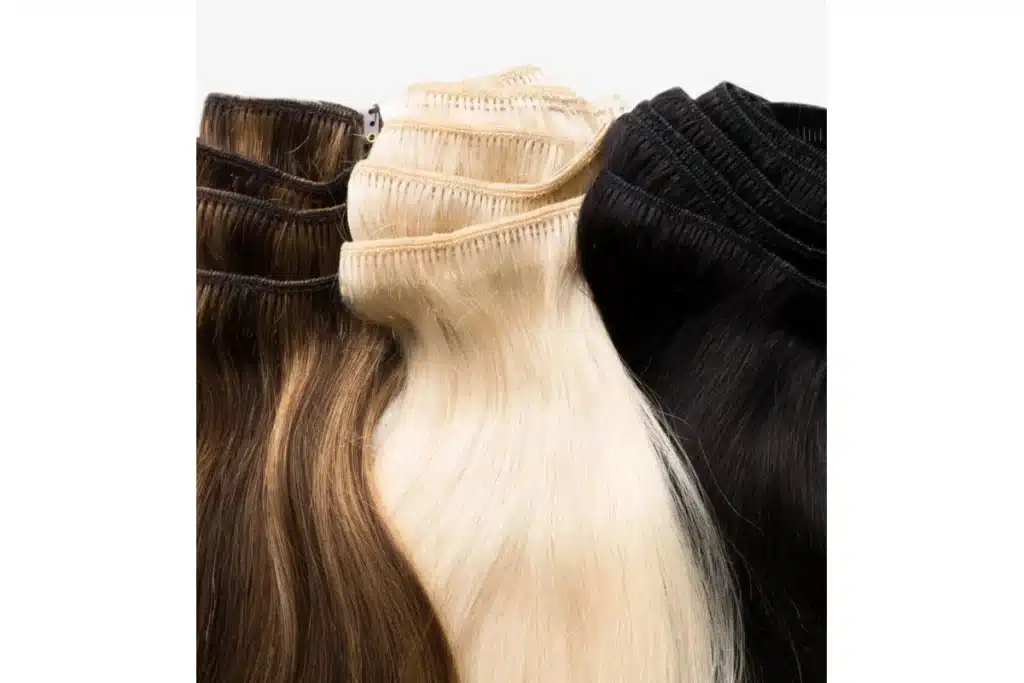
Wefts are long tracks of hair sewn onto rows anchored by micro-beads and thread. Modern options include:
- Machine Weft: Thickest seam, highly durable, customizable weight for thick hair.
- Hand-Tied Weft: Ultra-thin track, delicate, cannot be cut along the seam without unraveling.
- Genius Weft: The industry standard—combines the ultra-thin, flat profile of hand-tied hair with the ability to be cut anywhere along the track without shedding.
- Best For: Medium to thick hair density needing dramatic volume and length.
- Wear Time: 6–8 weeks before beaded row move-up.
- Install Time: 60–120 minutes.
5. Keratin Bond / Hot Fusion (U-Tip, Flat-Tip, K-Tip)
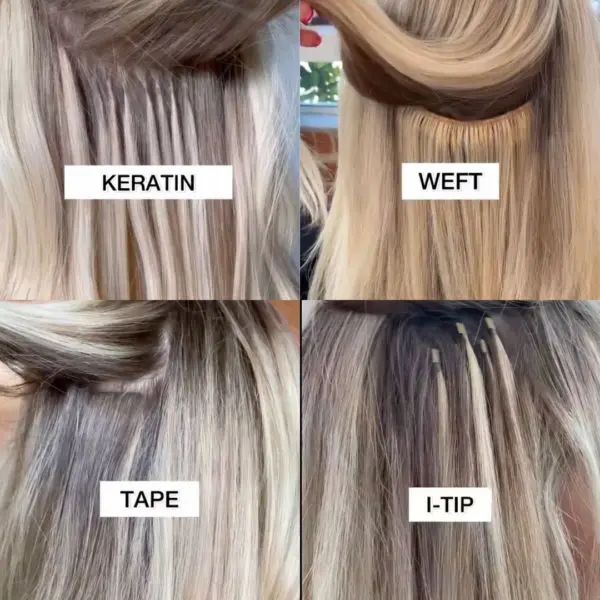
Keratin extensions involve individual hair strands pre-tipped with organic keratin polymer. A fusion heat wand melts the bond around natural hair bundles.
- Best For: Active lifestyles, high up-do wearers, long-term wearers.
- Wear Time: 3–4 months continuous wear.
- Install Time: 2–4 hours.
- Key Advantage: Provides 360-degree natural movement and precise customization.
6. I-Tip / Micro-Link Extensions (Cold Fusion)
I-Tip extensions feature a firm, cylinder-shaped tipped strand that is attached using a tiny copper or aluminum micro-bead squeezed tight with specialized pliers.
- Best For: Clients avoiding heat, chemical adhesives, or hot tool installation.
- Wear Time: 3–4 months total wear (requires bead move-up every 6–8 weeks).
- Install Time: 2–3 hours.
7. Nano Ring Hair Extensions
Nano rings use an ultra-small metal loop system that is 90% smaller than standard micro-beads.
- Best For: Fine hair, temple areas, and invisible strand-by-strand placement.
- Wear Time: Move-up required every 6–8 weeks.
- Install Time: 2–3 hours.
8. V-Light Curing Hair Extensions (Modern Tech)
V-Light technology uses a low-wattage UV/LED light device to cure a lightweight, transparent adhesive bond directly attaching loose extension hair to natural strands.
- Best For: Thinning crowns, hairline filling, side blending, ultra-fine hair.
- Wear Time: 6–8 weeks.
- Install Time: 30–60 minutes (targeted areas).
- Key Advantage: Completely weightless and customizable down to single hair strands.
Salon Decision Guide: How to Match Methods to Client Needs
When building a high-converting extension menu, match the application to client lifestyle rather than popularity alone:
- Fine / Fragile Hair:
- Daily Wear: Tape-In / Halo
- Long Term: Nano Ring / V-Light System
- Medium / Thick Hair:
- Maximum Volume: Genius Weft / Hand-Tied Row
- Strand Movement: Keratin Bonds / I-Tips

Factory Sourcing & Quality Guide for B2B Buyers
For salon owners, distributors, and online hair brands, choosing the correct method is only half the battle. Hair raw material quality determines retention rates and brand reputation.
Cuticle-Intact Remy Hair vs. Acid-Washed Non-Remy Hair
- Cuticle-Intact Raw/Remy Hair: All cuticles face the same natural direction. Stays silky after 30+ washes and remains reusable for 12+ months.
- Non-Remy / Chemical Hair: Cuticles are stripped using acid baths and temporarily coated with silicone. Tangles, mats, and degrades after 2–3 washes.
Factory Inspection Checklist Before Bulk Ordering
- Seam Construction: Check that Genius Wefts feature clean edge stitching without excess mustache hair.
- Bond Integrity: Test Keratin K-Tips with heat—high-quality Italian keratin won’t turn white or crumble during removal.
- Weight Consistency: Ensure each bundle maintains a strict 100g ±2g ratio without tapering off at the ends.
- Color Matching: Verify dye consistency across batch lots, especially for blonde tones (#60, #613, Balayage).

Frequently Asked Questions (FAQ)
What is the safest hair extension method for fine hair?
Tape-in extensions, Nano Rings, and V-Light extensions are generally considered the safest options for fine hair. They distribute weight evenly across natural hair strands, minimizing scalp tension and pull.
Which professional hair extension method lasts the longest?
Keratin bond (Hot Fusion) extensions offer the longest continuous wear without needing full reinstallation, typically lasting 3 to 4 months. High-quality Virgin/Remy hair from I-Tip or Weft methods can be reused for up to 12–18 months with regular move-up appointments every 6 to 8 weeks.
Can salon clients mix and match different extension methods?
Yes! Many top stylists combine methods for optimal results—for example, using Genius Wefts in the back for density and Tape-Ins or Nano Rings on the sides and crown for seamless, invisible blending.
Work with a Direct Hair Factory
At Hibiscus Hair Factory, we specialize in manufacturing premium, 100% cuticle-aligned human hair extensions for salon brands, wholesale distributors, and hair stores worldwide.
- Supported Methods: Genius Weft, Hand-Tied, Tape-In, K-Tip, I-Tip, Nano Ring, Halo, Clip-In.
- Services: Private Labeling, Custom Packaging, Color Ring Matching, and Sample Testing Support.
👉 Contact Hibiscus Hair Team Today for Wholesale Pricing & Free Factory Samples.