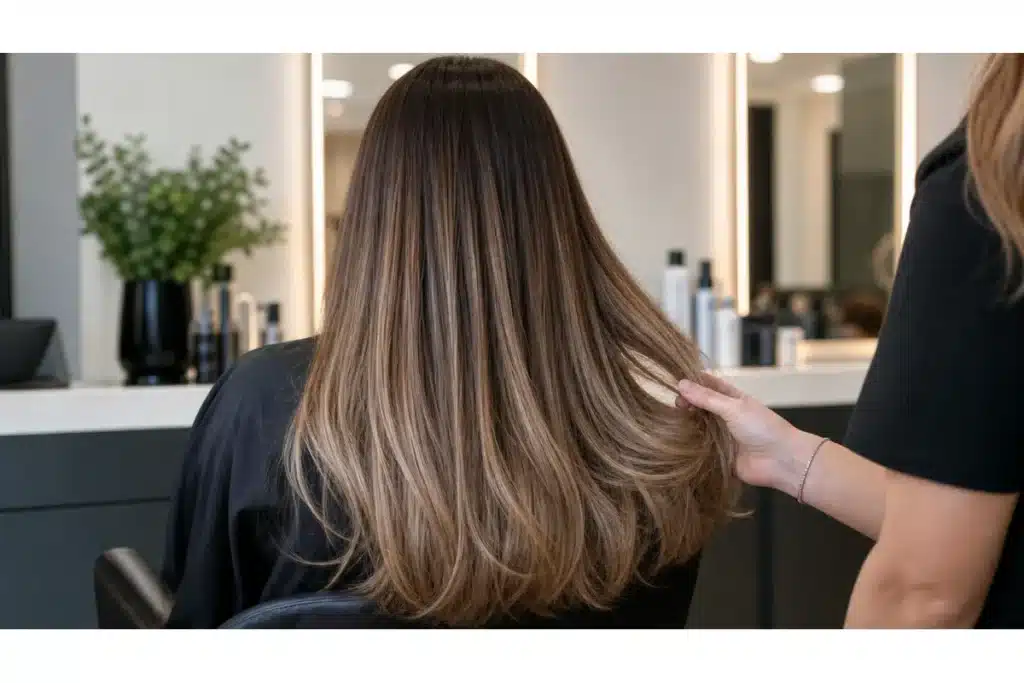
Flat crowns, thin ends, and slow styling push many clients to look for fast, low-risk options. Halo hair extensions stand out because they can add visible length and volume in under a minute, with no glue, no tape, and no beads. But the result still depends on fit, blending, weight, and how well the halo matches the client’s real hair.
Halo hair extensions are a removable, one-piece extension system attached to a thin clear wire that sits around the head like a hidden band. They add length and volume quickly with no permanent attachment, no salon install, and very low stress on the natural hair. They are especially useful for busy clients, event styling, and many thin-hair users, but correct placement and blending still decide whether the result looks natural.
Halo is one of the easiest extension systems to wear, but it is also one of the most misunderstood. The real question is not only what halo is. The better question is who it suits, when it looks natural, and what makes one halo work better than another.

What Are Halo Hair Extensions?
Halo hair extensions are a removable, one-piece extension system. The hair is attached to a base, and that base is connected to a thin, clear wire. The wire sits around the head, usually below the crown and above the ears, while the client’s own top layer of hair covers the base.
The key difference is that halo does not attach directly to the roots in the way tape-ins, keratin bonds, or wefts do. The weight is balanced by the wire and the position of the base, not by fixed attachment points on the natural hair.
That is why halo feels very different from long-wear methods. It is:
- fast to put on
- fast to remove
- easy to store
- low commitment
- low stress on the scalp
This also explains why halo is popular with:
- beginners
- event clients
- brides and wedding guests
- travel users
- people who want volume without salon installation
- clients who are unsure whether they want a permanent extension method
Construction and Materials
Halo may look simple, but the construction still matters a lot.
The usual structure includes:
Base
The base may be made from:
- lace
- mesh
- slim fabric track
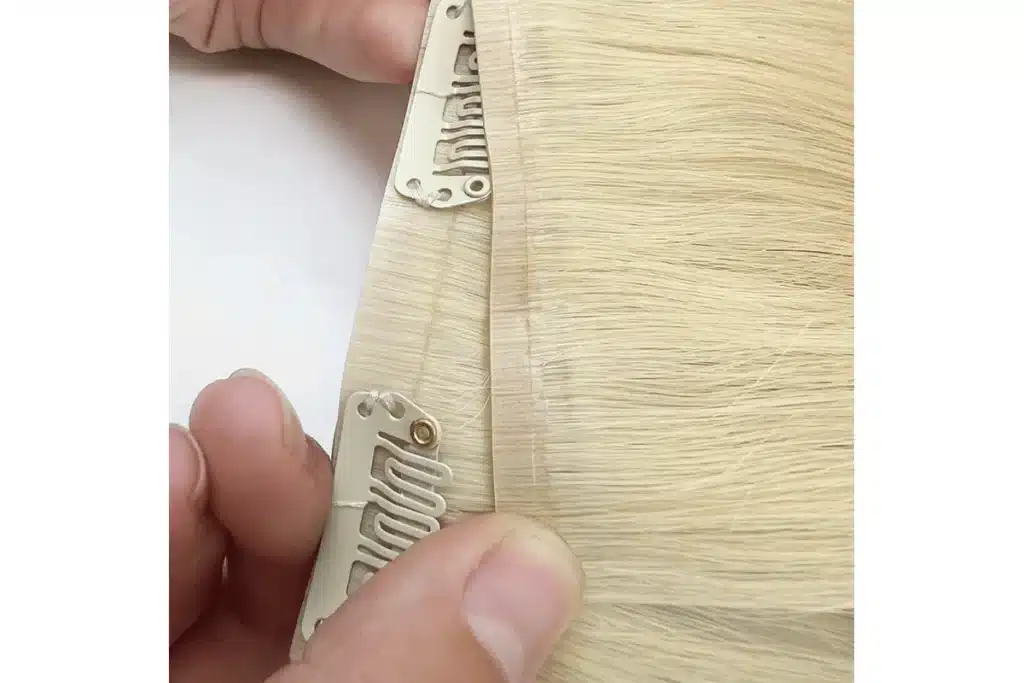
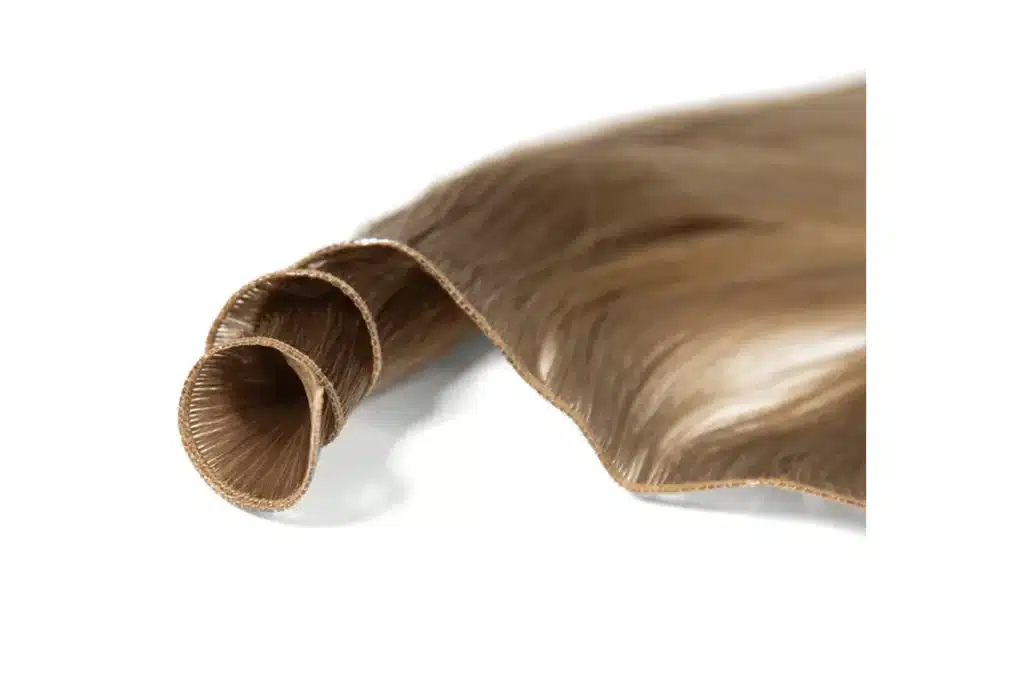
Some halos use a machine weft construction. Some use softer, lighter perimeter finishing. Better bases usually sit flatter and feel less bulky under the top veil of natural hair.
Wire
The wire is usually:
- clear nylon filament
- elastic monofilament
Some halos also include optional side stabilizer clips, but the core halo concept is still one piece supported by the wire.
Hair
Halo hair can be:
- synthetic
- human hair
- Remy human hair
- full cuticle single-donor human hair
Higher-quality human hair usually blends better, styles better, and lasts longer. That is especially important for clients who want to curl, tone, or wear the halo regularly.
| Spec | Typical Options | Why It Matters |
|---|---|---|
| Length | 12″, 14″, 16″, 18″, 20″, 22″, 24″ | Longer lengths usually need more grams to avoid thin ends |
| Weight | 80–120 g, 140–180 g, 200 g | More grams give more density, but too much can reduce natural blending |
| Base width | 9–11 inches | Width affects stability and side coverage |
| Wire type | Nylon or elastic | Elastic can improve comfort; nylon usually holds shape better |
| Hair grade | Synthetic, Human Remy, Full Cuticle | Hair quality changes blending, lifespan, and styling performance |
Why Clients Choose Halo
Clients usually choose halo for very practical reasons.
They want:
- instant volume
- instant length
- no permanent attachment
- no root stress
- no salon commitment
- something they can wear only when they need it
Halo is especially attractive to clients who say things like:
- I only need it for weekends
- I want more hair for photos
- I do not want tape or glue
- I want something I can remove myself
- I want to test longer hair before doing something more permanent
That is why halo is not just a beauty product. It is also a convenience product.
Are Halo Extensions Good?
Yes, halo extensions are good when the client wants speed, low commitment, and a low-risk way to add length and volume.
They are especially strong in three areas:
1. Speed
Halo is one of the fastest extension systems to use. Once the wire is adjusted properly, many clients can put it on in 30 to 60 seconds.
2. Comfort
There is no adhesive, no tape tab, no beads, and no stitched row. That makes halo much more comfortable for many users, especially people who dislike the feeling of permanent installs.
3. Low root stress
Halo does not pull on the follicles the way badly installed permanent systems can. That makes it a safer-looking option for clients who are cautious about tension.
But halo is not ideal for everything.
It is less suitable for:
- high, tight ponytails
- top knots
- intense athletic movement
- swimming
- clients with very short top layers
- people who want a fully “set and forget” long-wear method
So halo is good, but it is good for specific needs. It is not a replacement for every extension system.
Who Is Halo Best For?
This is one of the most useful ways to judge halo.
Halo is usually best for:
Beginners
Clients who are new to extensions often feel more comfortable starting with halo because the system is simple and removable.
Event styling
For weddings, parties, photoshoots, and social events, halo works very well because it creates visible transformation very quickly.
Busy clients
Some clients do not want appointments, move-ups, bond care, or row maintenance. Halo fits that lifestyle much better.
Thin-hair clients who want low commitment
For many thin-hair users, halo gives volume with much less psychological stress than a permanent install.
Salons selling retail-friendly solutions
Halo is also useful from a salon business angle because it is an easy retail add-on and can serve clients who are not ready for permanent methods.

Who Should Avoid Halo or Use It More Carefully?
Halo is easy to use, but it is not ideal for everyone.
More caution is needed for:
Very short hair
If the natural top hair is too short, it becomes much harder to cover the base well. Hair above jawline can be especially difficult without skilled blending.
Clients wanting very high styles
High ponytails and top knots usually expose the wire or base more easily.
Very active users
If the client does intense workouts, strong movement, or sports with a lot of head motion, halo may feel less secure than a more fixed method.
Clients expecting permanent wear
Halo should be removed after use. It is not a sleep-in, swim-in, everyday fixed attachment method.
Extremely sparse top coverage
If the top veil of natural hair is too weak, the halo may become visible more easily.
So halo works best when the client’s goal matches what the system is built to do.
How Do Halo Extensions Work?
The system is simple in concept, but natural-looking results still depend on correct fit and placement.
Halo works by balancing the weight of the extension on a thin wire that sits around the parietal area of the head. The client’s own hair covers the base, so the visible result looks like fuller natural hair rather than a clearly attached extension piece.
The key idea is this:
halo does not “grip” the roots. It “rests” in position and is hidden by the top veil.
That is why most halo problems do not come from the wire itself. They usually come from:
- wrong wire tension
- wrong placement
- not enough top hair covering the base
- too much weight for the client’s density
- poor color or texture matching
Basic fitting steps
- Place the wire around 1–1.5 inches behind the hairline
- Adjust the wire so it feels secure but not tight
- Let the base sit in the occipital area so it locks more naturally into position
- Pull a clean horseshoe section of natural hair over the base
- Blend the halo hair and natural hair together with styling if needed
- Add optional low-pressure clips only if extra stability is necessary
The system is simple, but the result still depends on balance. A halo that is placed too far forward or too tightly usually becomes less comfortable and more visible.

Can You See Halo Hair Extensions?
This is one of the most important user questions.
With correct fit, enough top-hair coverage, and the right color and texture match, halo should not be visible in normal wear.
The wire usually becomes visible for practical reasons, not random reasons.
The most common causes are:
- wire too close to the hairline
- top veil too thin
- color too flat
- texture mismatch
- too much weight for the client’s density
- very short top layers
The three things that control visibility most
1. Fit
If the wire sits too far forward, it is easier to flash in bright light or movement.
2. Coverage
The top layer of natural hair must be thick enough to cover the base naturally.
3. Finish
A halo that matches color depth, root softness, and texture usually disappears much better than one that is technically “close” but visually off.
Quick visibility fixes
| Visibility Issue | Likely Cause | Quick Fix |
|---|---|---|
| Wire line shows | Wire too close to hairline | Move wire back slightly |
| Base ridge shows | Top veil too thin | Drop more natural hair over the base or reduce grams |
| Color seam shows | Flat color choice | Use rooted shade or add lowlights |
| Texture seam shows | Wrong texture match | Match body wave, straight, or curl pattern more closely |
A useful professional rule is this:
most visible halos are not bad halos. They are poorly matched or poorly positioned halos.
Best Halo Hair Extensions for Thin Hair
Thin hair is one of the strongest real use cases for halo, but it still has to be handled correctly.
Halo is often a good option for thin hair because it does not attach directly to the follicles. That means many clients who are nervous about tapes, beads, or bonds feel more comfortable starting with halo.
But thin hair is not automatically easy. The wrong halo can still look obvious.
What usually works best for thin hair
Lighter grams
For many thin-hair clients, 80–120 g is a better starting point than heavy dramatic weights. Too much hair can flatten the top veil and make blending harder.
Shorter to medium lengths
14–18 inches often look more believable on thin hair than very long heavy lengths, especially when the client’s own ends are fine.
Soft edge construction
Softer perimeter finishing and lighter corners help reduce ridge visibility near the temples.
Shadow root
A slight root shadow or deeper root tone helps hide the base and makes the blend look more natural.
Subtle texture
Body wave often works very well for thin hair because it gives more grip, softens blending lines, and reduces the obvious seam effect that very straight shiny hair can create.
| Feature | Thin-Hair Friendly Choice | Why It Helps |
|---|---|---|
| Grams | 100–120 g | Gives fullness without collapsing the top veil |
| Length | 14″–18″ | Easier to blend and less visually heavy |
| Base edge | Soft or hand-finished perimeter | Reduces temple bulk |
| Root color | Shadowed or rooted | Hides seam more naturally |
| Texture | Body wave | Adds grip and softens contrast |
What often goes wrong on thin hair
- too much weight
- too much length
- top layer too short
- wrong shine level
- no root dimension
- wire placed too close to the front
So yes, halo is often good for thin hair, but only when the halo is built and fitted for thin hair, not just sold to thin hair.

How Long Do Halo Extensions Last?
Halo lifespan depends on hair quality, wear frequency, heat use, wash routine, and storage habits.
A simple way to think about halo lifespan is this:
the hair quality sets the ceiling, but care habits decide how close the client gets to that ceiling.
Hair material tiers
Non-Remy
Often around 1–2 months in practical wear. More tangling is common once the outer coating wears off.
Remy hair
Usually around 3–6 months with careful use and moderate heat.
Full cuticle, single-donor hair
This is the strongest long-term option. With good care, it can last about 1 year or even longer in some user routines.
What changes halo lifespan most?
- hair quality
- how often the client wears it
- how often it is heat styled
- whether it is washed correctly
- whether it is stored flat and dry
- whether the wire and base are handled gently
Care habits that shorten halo life
- daily high heat
- soaking the seam area carelessly
- sleeping in the halo
- storing it damp
- using heavy oils or silicones
- letting it rub loosely without proper storage
| Factor | Shortens Life | Extends Life |
|---|---|---|
| Heat | Daily high-heat styling | Lower heat with protectant |
| Water | Rough soaking and seam stress | Careful off-head washing |
| Products | Heavy buildup products | Light end-focused products |
| Wear pattern | Sleeping in halo | Removing after wear and storing well |
So when people ask how long halo lasts, the practical answer is not only “6 months” or “12 months.” It depends heavily on quality and routine.

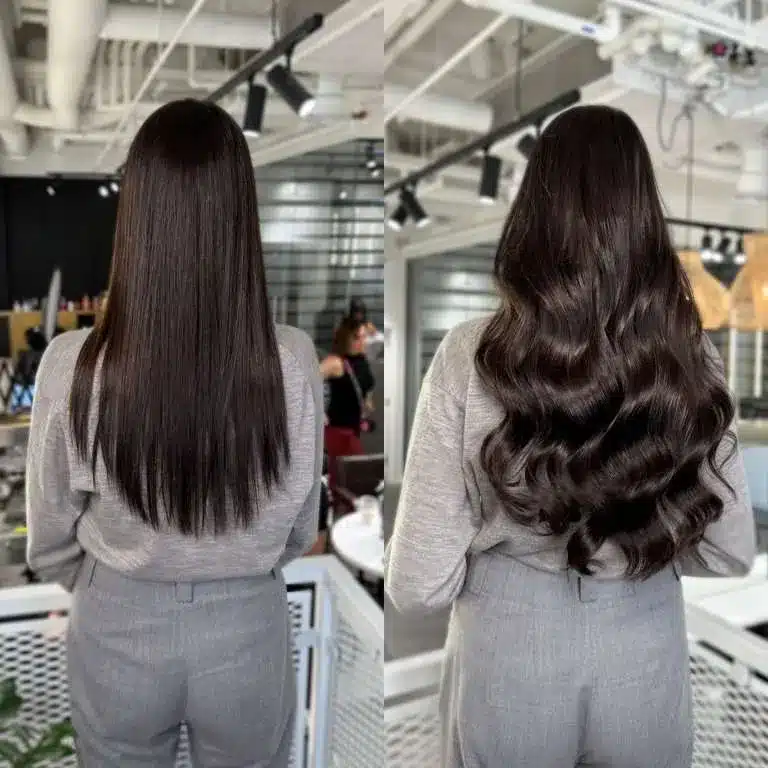
Halo Hair Extensions Before and After
Before-and-after is one of the easiest ways to understand what halo is really good at.
Typical “before” situations include:
- flat crown
- thin ends
- unfinished-looking length
- hair that needs too much styling time to look full
Typical “after” results include:
- fuller overall outline
- thicker-looking ends
- better side balance
- longer-looking shape
- faster styling result with less commitment
Halo is not a miracle solution for every haircut. But for the right client, the visual difference can be very strong, especially when the issue is not severe hair loss, but lack of fullness and shape.
%halo hair extensions before and after

Most Common Halo Mistakes
Halo is simple, but people still make the same mistakes repeatedly.
The most common ones are:
1. Putting the wire too close to the hairline
This makes visibility much more likely.
2. Choosing too much weight
More hair is not always better. On fine hair, too much weight often makes the halo harder to hide.
3. Choosing the wrong color depth
Even if the shade looks close, a flat color without root softness can make the seam more obvious.
4. Using too little top coverage
If the natural top veil is too thin, the base becomes much easier to see.
5. Sleeping in the halo
This shortens lifespan fast and can distort the wire.
6. Storing it wet or tangled
A removable system still needs proper care between wears.
Most halo problems are not product failures. They are fit, choice, or handling mistakes.
My View
From a manufacturing angle, halo is one of the best low-risk, retail-friendly extension systems in the market. It is fast, flexible, easy to understand, and much less intimidating than permanent methods.
But a halo only looks easy when the fit and design are correct. In real use, the best halo results come from the same things that matter in every extension category: correct grams, realistic length, proper root dimension, good texture match, and hair quality that can hold its finish.
For thin-hair clients, that usually means lighter grams, softer edges, and a rooted color choice. For glamorous longer looks, it means more grams and better blending. So my view is simple: halo is a very good system when it is matched properly. It is not just “one piece on a wire.” It still needs the right build for the right client.
FAQ
Can you wear a halo with very short hair?
You can if the natural hair reaches at least jawline length, but blending becomes harder as the top gets shorter.
Can clients exercise in a halo?
Light movement is usually fine. For intense workouts, halo is less ideal because sweat and movement can shift the wire.
Can you swim with a halo?
It is better not to. Remove it before swimming.
Can you sleep in a halo?
No. Halo should be removed before bed.
Can you curl and straighten halo hair?
Yes, if it is human hair. Use heat protectant and moderate temperatures.
Can you color a halo?
Human hair halo can usually take deposit-only toners or root-shadow work. Harsh lightening is much riskier.
How do you clean a halo?
Wash it off-head every few wears, keep products lighter near the base, and dry it fully before storage.
Are halo extensions good for thin hair?
Yes, often they are, especially when the grams are light, the root is shadowed, and the fit is slightly farther back for stability.
Can people see halo hair extensions?
Not usually, if the wire position, top veil, weight, and color match are correct.
How long do halo extensions last?
It depends on the hair quality and care routine. Human hair usually lasts much longer than synthetic, and full cuticle hair lasts the longest.
Conclusion
Halo hair extensions are a fast, gentle, and practical option for clients who want instant length and volume without permanent attachment. The best results come from correct fit, enough top coverage, realistic grams, and good color and texture matching. When those parts are right, halo can look natural, feel comfortable, and work especially well for busy users and many thin-hair clients.