Thin hair clients usually do not ask for “more hair” only. They ask for volume without visible bonds, root tension, breakage, or a result that looks too heavy for their natural hair.
For thin hair, the safest hair extension options are usually tape-ins, nano or micro bead extensions, halo extensions, and some lightweight wefts. The best choice depends on the client’s hair density, scalp sensitivity, lifestyle, maintenance ability, and how much weight the natural hair can safely support.
For salons, this is not just a product choice. It is a risk-control decision. If the method is too heavy or the placement is wrong, the client may blame the salon, even when the product itself is not the only problem.

What Should Salons Check Before Choosing Extensions for Thin Hair?
Before choosing any extension method, the stylist should check the client’s natural hair density, hairline strength, scalp condition, breakage history, chemical processing, and daily styling habits.
Thin hair does not always mean weak hair. Some clients have fine but healthy hair. Some clients have fragile hair from bleaching, heat styling, hormones, stress, or poor previous extension work. These two clients should not receive the same extension plan.
| What to Check | Why It Matters | Safer Salon Decision |
|---|---|---|
| Hair density | Decides how much weight the hair can support | Use fewer pieces or lighter grams |
| Hairline strength | Thin hairlines expose bonds easily | Avoid heavy front placement |
| Scalp sensitivity | Affects comfort and tension risk | Choose flatter or temporary methods |
| Breakage history | Shows whether hair can handle extensions | Delay service if hair is too weak |
| Lifestyle | Affects maintenance success | Match method to daily habits |
| Maintenance ability | Thin hair needs careful follow-up | Schedule regular checkups |
For salons, this consultation protects the client and the business. Many complaints start when thin hair receives the wrong weight, not when the extension method itself is bad.
What Type of Hair Extensions Are Best for Thin Hair?
The best hair extensions for thin hair are usually lightweight, flat, discreet, and easy to maintain. The goal is not to add the most hair. The goal is to add enough hair without creating visible attachment points or root tension.
For most thin hair clients, tape-ins, nano or micro bead extensions, halo extensions, and carefully selected lightweight wefts are safer options than heavy, bulky systems.
1. Tape-In Hair Extensions
Tape-in extensions are often a good choice for thin hair because the tabs are flat and the weight can be spread across a wider area. When the sectioning is correct, tape-ins can sit close to the head and blend better than many bulky methods.
But tape-ins are not automatically safe for every thin hair client. The stylist still needs to control weight, placement, adhesive care, and maintenance timing.

Why tape-ins can work well for thin hair
- Flat application: The tape tab sits flatter than many strand-by-strand attachments.
- Better weight spread: The weight can be distributed across thin sections.
- Natural blend: Good placement can help the tabs stay discreet.
- Maintenance-friendly: Tape-ins can be moved up every 6–8 weeks.
- Reusable option: Good-quality hair can often be reused with new tape tabs.
The key is correct weight. Too many tape pieces can still create stress, especially around the hairline and crown.
Tips for using tape-ins on thin hair
- Use smaller and cleaner sections.
- Avoid placing tapes too close to fragile hairlines.
- Do not overload the head with too many pieces.
- Keep conditioner, oil, and heavy products away from the tape tabs.
- Schedule maintenance before grown-out tapes start pulling.
For hair salons, tape-in extensions are generally one of the safest semi-permanent extension methods for fine, soft hair—but with one caveat: the client must be able to follow the necessary daily care requirements.
When selecting tape-in hair extensions for clients with fine or soft hair, professional buyers can compare the thickness of the tape, the strength of the adhesive, and the weight specifications.
Why Tape-Ins Are Ideal for Thin Hair
2. Nano or Micro Bead Extensions
Nano and micro bead extensions can work for some thin hair clients because they do not use heat or glue. They also allow flexible strand-by-strand placement.
But they are not always the safest choice for very fragile hair. If the bead is too heavy, too tight, or placed on too small a natural hair section, it can create tension.

Why nano or micro beads may work
- No heat or glue is needed.
- Placement can be customized.
- Small beads can be discreet when color-matched well.
- The method can be adjusted during maintenance.
The risk is tension. Thin hair needs careful bead size, strand weight, and section control.
Tips for using beads on thin hair
- Use lightweight strands.
- Match bead size to the client’s hair density.
- Avoid over-tight clamping.
- Do not place beads on weak front hairline areas.
- Check for slippage or breakage during maintenance.
For salon owners, bead methods require skill. A poor install can create more complaints on thin hair than on thick hair.
3. Halo Hair Extensions
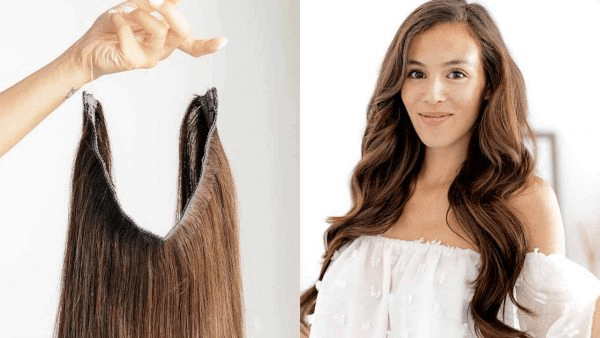
Halo extensions are a good low-commitment option for very thin or fragile hair because they do not use tape, glue, beads, or heat. The wire supports the extension, so the natural hair does not carry the same attachment stress.
Halo extensions are best for temporary volume, events, photoshoots, and clients who want to test extensions before choosing a semi-permanent method.
Why halo extensions may be safer for fragile hair
- No adhesive, beads, or heat are used.
- They can be removed daily.
- They are useful for temporary styling.
- They create volume without permanent attachment.
The limitation is security. Halo extensions may not suit every active lifestyle, and the wire must be adjusted correctly to avoid discomfort or visibility.
Tips for using halo extensions on thin hair
– Choose lightweight hair, not an overly heavy set.
– Adjust the wire so it feels secure but not tight.
– Blend the top layer carefully to hide the wire.
– Use halo extensions for temporary volume rather than long-term wear.
– Avoid sleeping or exercising heavily with halo extensions.
For salons, halo extensions are useful when the client is not ready for tape-ins, beads, or wefts.
Better Product Choice for Thin Hair Clients
Thin hair needs lightness, flatness, and controlled placement. The wrong structure can look bulky or create tension.
| Extension Method | Good for Thin Hair? | Best Use | Main Risk |
|---|---|---|---|
| Tape-ins | Yes, often a strong choice | Fine to medium-thin hair needing volume | Too many tabs or poor aftercare |
| Mini tape-ins | Yes | Very fine areas or small placement zones | Lower density per piece |
| Nano beads | Sometimes | Clients wanting no glue or heat | Tension if placed incorrectly |
| Micro beads | Sometimes | Medium-fine hair with enough support | Bead visibility or slipping |
| Halo extensions | Yes for temporary use | Very fragile hair or event styling | Wire visibility or poor fit |
| Lightweight wefts | Sometimes | Thin but strong hair needing volume | Row weight and visibility |
| Heavy machine wefts | Usually not first choice | Thick hair clients | Too much weight for thin hair |
The safest product is not always the most invisible one. The safest product is the one the client’s natural hair can support.
Professional Notes for Salons and Hair Brands
Thin hair clients need more education than thick hair clients. They often worry about visibility, damage, slipping, and whether the extensions will make their natural hair worse.
For salons, the consultation should be honest. If the client’s hair is too fragile, the safer decision may be to delay the service, choose halo extensions, or use fewer pieces.
For hair brands and wholesale buyers, thin hair products should not be selected only by softness. The product must be light, flat, stable, and easy to explain to stylists.
A good supplier should explain the limits clearly. Not every method fits every client. Not every thin hair client should receive a full-head install.
FAQs About Hair Extensions for Thin Hair
What hair extensions are best for thin hair?
Tape-ins, mini tape-ins, halo extensions, and some nano bead methods are often better for thin hair because they can be lighter and flatter. The best choice still depends on hair density and scalp condition.
Are tape-in extensions good for thin hair?
Yes, tape-ins can be good for thin hair when the stylist uses the right weight, clean sectioning, and proper placement. Too many tape pieces can still create tension.
Can you get extensions with very thin hair?
Sometimes, yes. But if the hair is very weak, shedding heavily, or recently damaged by chemicals, a temporary method like halo extensions may be safer.
What are the least damaging extensions for thin hair?
The least damaging option is the one with the lowest tension for that client. Halo extensions are low-commitment, while tape-ins and nano beads can work when installed carefully.
Do extensions make thin hair worse?
Extensions can make thin hair worse if they are too heavy, installed too tightly, worn too long without maintenance, or removed incorrectly.
Should salons test samples for thin hair clients?
Yes. Salons and buyers should test weight, flatness, color match, softness after washing, shedding, attachment comfort, and reuse performance before offering products to thin hair clients.

Conclusion
The best hair extensions for thin hair are usually lightweight, flat, and low-tension. Tape-ins, mini tape-ins, halo extensions, and some nano bead methods can work well when the client’s natural hair can safely support them.
For salons, the safest result starts with honest consultation and careful placement. For hair brands and wholesale buyers, the safest business decision starts with sample testing for weight, softness, attachment comfort, color match, and reuse performance.
You can contact Hibiscus Hair to request low-tension product recommendations or samples for fine and thin hair clients.