Your clients demand natural volume but refuse heat or glue damage. You need a method that offers invisibility and safety without compromising on quality or hold.
To install micro link extensions, thread a small section of natural hair through a micro bead using a loop tool. Insert the I-tip, Nano tip or F-tip extension into the bead alongside the hair. Clamp the bead flat using pliers to secure the bond near the roots without heat or chemicals.

As a factory, We have seen this method grow in popularity among top salons in the USA/Canada and UK. It requires skill, but the results are worth the effort. Let me walk you through the technical details to master this service for your business.
What are micro link hair extensions?
Confusion exists about terminology in the hair market. You must understand the specific mechanics to explain them to your high-end clientele effectively.
Micro link hair extensions, also called micro beads or loop extensions, are a cold-fusion method. They attach individual strands of extension hair to natural hair using small metal rings lined with silicone, requiring no heat or adhesive for application.
We need to define exactly what these extensions are because the names often change depending on the brand. In my factory, we classify these as “Cold Fusion” extensions. This means we do not use a heat gun or melted keratin glue to attach them. This is a major selling point for clients who are afraid of heat damage.
The system relies on three specific components working together. First, you have the natural hair. Second, you have the extension strand. Third, you have the connection unit, which is the bead or ring. The bead is usually made of aluminum or copper. At Hibiscus Hair, we line our beads with silicone. This silicone layer acts as a cushion. It protects the natural hair from the hard metal and prevents the extension from sliding down.
There are three main types of extensions used with this method. You need to know the difference to order the right stock for your salon.
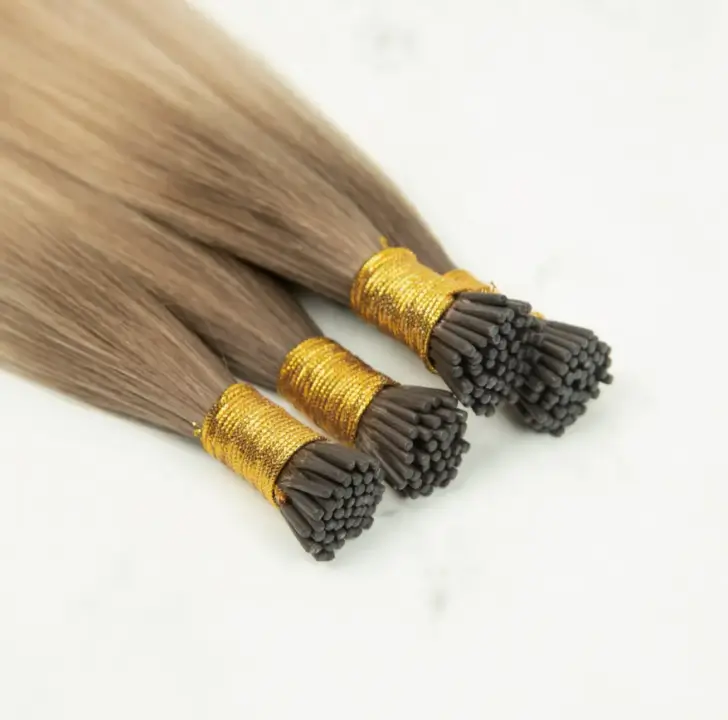
1. I-Tip Extensions
This is the classic style. The top of the hair strand is bonded with keratin into a stick shape, like a shoelace tip. It fits into a standard size micro bead (typically 4mm or 5mm). This is the most durable option for clients with normal to thick hair density because the bond is sturdy.
2. Nano Tip Extensions
These are designed for invisibility. The bead used here is 90% smaller than a standard micro bead. The “tip” is usually a tiny metal wire loop or a hard metal pin. While excellent for thin hair, the metal tip can sometimes feel rigid or trigger metal detectors if the client has a full head installation.
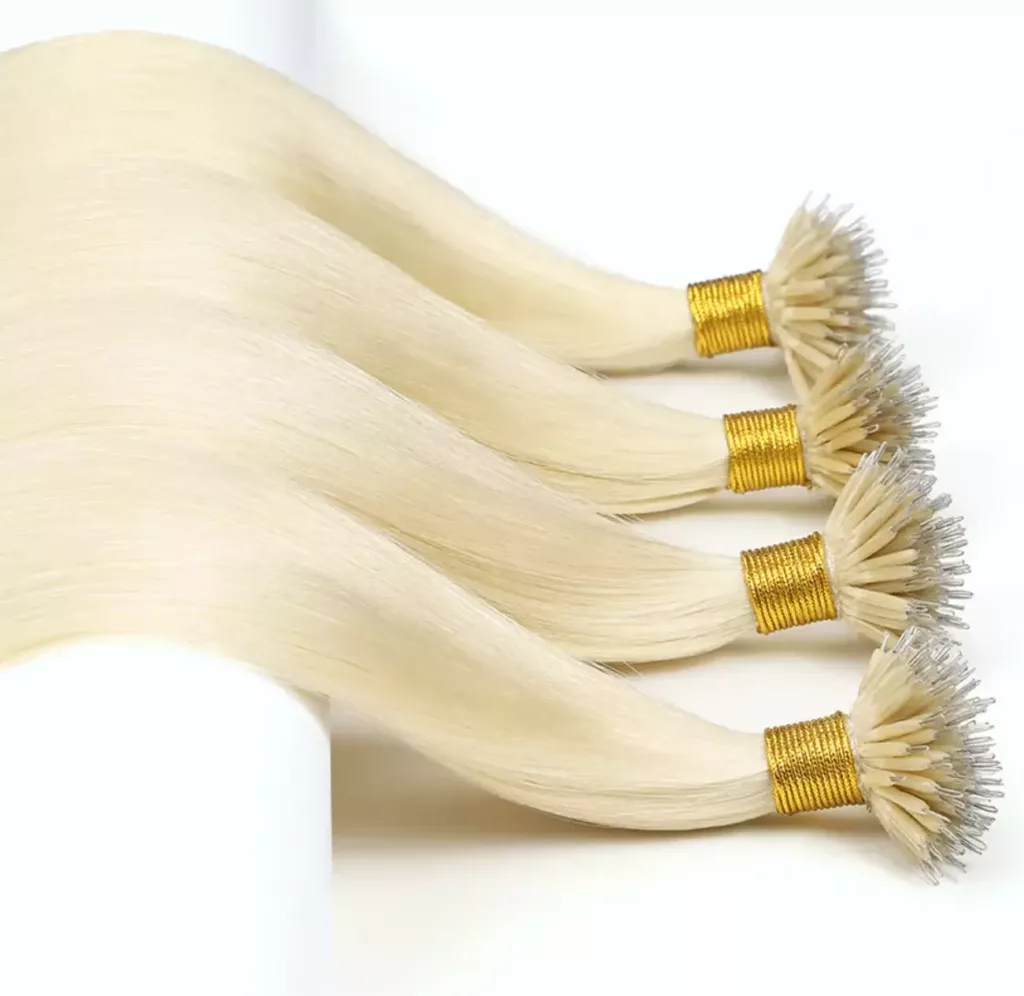
3. F-Tip Extensions (Plastic Nano Tip)
This is the modern upgrade to the Nano tip. “F” stands for flexible or plastic. Instead of a metal wire, the tip is made of a soft, medical-grade plastic or synthetic polymer. It fits into the tiny nano bead just like the standard nano tip, but it is much softer. It is easier to install because the plastic tip glides into the bead smoothly, and it causes zero damage because there is no metal rubbing against the natural hair inside the bead. It is the most comfortable option for clients with sensitive scalps.

Here is a quick comparison for your inventory planning:
| Type | Tip Material | Bead Size | Benefit |
|---|---|---|---|
| I-Tip | Hard Keratin | Standard (4mm-5mm) | High durability for thick hair. |
| Nano Tip | Metal Wire | Tiny (2mm-3mm) | Invisible for fine hair. |
| F-Tip | Soft Plastic | Tiny (2mm-3mm) | Softest feel, easy install, safest. |
How install micro link hair extensions?
Precise application determines the longevity of the extensions. You cannot rush this process if you want to maintain a reputation for excellence.
Section the hair cleanly. Thread the natural hair through the bead using a pulling loop. Insert the I-tip or F-tip extension into the bead. Clamp the bead firmly with pliers. Repeat this row by row, leaving space for movement and concealment.
The installation process is where your skill as a stylist truly shows. I have watched thousands of stylists test our hair. The ones who succeed are the ones who follow a strict system. You need the right tools before you start: a loop tool (or pulling needle), extension pliers, sectioning clips, and a tail comb.
Step 1: Precise Sectioning
Clean sections are the most important part. You must create clean horizontal rows. Start at the nape of the neck. Leave about one or two inches of natural hair at the bottom hairline. If you put beads too low, they will show when the client puts her hair up.
Step 2: The Ratio of Weight
This is where many people make mistakes. You must grab a section of natural hair that matches the weight of the extension strand.
- If you take too little hair, the weight of the extension will pull it out. This causes traction alopecia.
- If you take too much hair, the bead will not fit, or it will pop open later.
- The ideal ratio is 1:1. The density of the supporting hair must equal the density of the added hair.
Step 3: Threading and Insertion
Slide the bead onto the loop tool. Pull the section of natural hair through the loop and slide the bead up near the root. Do not put it directly against the scalp. Leave about 1 centimeter of space. This space allows the hair to move freely without pulling. Once the bead is in place, insert the extension tip (I-tip or F-tip) into the bead.
Step 4: Clamping
Hold the bead steady. Use your pliers to clamp the bead shut. You should clamp it flat. Some stylists clamp it like a book (folding it), but clamping it flat is usually more comfortable for the client. Ensure the tip and the natural hair are both securely inside before you squeeze.
Common Installation Errors to Avoid:
| Error | Consequence | How to Fix |
|---|---|---|
| Too close to scalp | Pain and tension spots. | Leave 5mm – 1cm of space. |
| Cross-hairs | Tangles and pulling. | Ensure clean square sections. |
| Uneven clamping | Extension slides out. | Apply even pressure with pliers. |
| Overloading | Hair loss (Alopecia). | Match strand weight correctly. |
How long do microlinks take to install?
Time is money in your salon business. You need to schedule appointments accurately to maximize your daily revenue and efficiency.
A full head installation typically takes 2 to 4 hours, depending on the client’s hair density and the stylist’s speed. A half-head for volume might take 1.5 hours, while complex corrections can take up to 5 hours.
When I speak with salon owners like Agila, they often ask how to price this service. The price depends on the time. Micro links are not a fast service like tape-ins. They are a labor-intensive luxury service. You are touching every single strand of hair.
Several factors influence the total time in the chair.
1. The Volume Desired
A “full head” usually means 150 to 200 grams of hair. In my factory, one pack is usually 50 grams or 100 grams.
- 100 grams (approx. 100 strands): 2 hours.
- 150 grams (approx. 150 strands): 2.5 hours.
- 200 grams (approx. 200 strands): 3 hours.
You have to physically install 150 to 200 individual beads.
2. The Texture Match
If you are blending textures, it takes longer. For example, if you are installing curly I-tips on a client with blown-out hair, you have to be very careful with sectioning to ensure the curl pattern falls correctly.
3. The Stylist Experience
A junior stylist might take 5 hours for a full head. A master stylist can do it in 2.5 hours. Speed comes with muscle memory. I suggest you practice on a mannequin head until you can install one row in 15 minutes. Using F-tips can sometimes speed up the process slightly because the plastic tip is flexible and enters the tiny nano bead easier than a rigid metal wire.
4. Cutting and Blending
The installation is only 80% of the job. You must cut the hair to blend it. Since micro links are strand-by-strand, they blend easier than wefts, but you still need 30 minutes for the final cut.
Here is a realistic schedule to book for your clients:
| Service Type | Strand Count | Estimated Time |
|---|---|---|
| Volume Only | 50 – 75 strands | 1.5 Hours |
| Length & Volume | 125 – 150 strands | 3 Hours |
| Mega Volume | 200+ strands | 4.5 Hours |

Are microlinks worth it?
Your clients hesitate at the high price point. You must articulate the long-term value and quality benefits to close the sale confidently.
Yes, they are worth the investment for clients seeking reusability. The hair lasts 1-2 years with proper care, and maintenance appointments cost less than new sets. The natural movement and lack of damage justify the initial cost.
As a manufacturer, I know the cost of raw materials. Micro link extensions (I-tips and F-tips) are expensive to produce because we must bond the tips perfectly. However, for the client, they offer the best Return on Investment (ROI).
The Reusability Factor
With Keratin (U-Tip) extensions, you cut the bond off when you remove them. You cannot reuse that hair easily. With micro links, the hair remains intact. When the hair grows out, you simply open the bead, push the hair up, and clamp it shut again. Or, you replace the bead for a few cents. The expensive part (the hair) is used over and over again. If you buy high-quality Hibiscus Hair, that same hair can last for 12 to 24 months.
Natural Movement
Wefts can feel stiff. Tapes can flop. Micro links have “360-degree movement.” Each strand moves independently. The client can run her fingers through her hair and feel her scalp. This feeling of freedom is a luxury that clients are willing to pay for.
Cost Breakdown for the Client
You should explain the math to your client.
- Initial Cost: High (Buying hair + long install time).
- Maintenance Cost: Low (Just a move-up service every 6-8 weeks).
- Replacement Cost: Low (You do not buy new hair for a year).
Compared to tape-ins, where the glue residue ruins the hair over time, micro links keep the extension hair clean. The total cost of ownership over one year is actually lower than tape-ins or keratin bonds, even if the start price is higher.
Can you wash your hair with microlinks?
Clients worry about hygiene and daily maintenance. You must provide clear aftercare instructions to prevent matting and ensure client satisfaction.
Clients can wash their hair, but they must be gentle. They should wash vertically without scrubbing the roots vigorously. Using sulfate-free shampoo and avoiding conditioner on the bonds keeps the beads secure and prevents slipping.
One of the biggest myths is that you cannot wash your hair. Of course, you can. Hygiene is essential for a healthy scalp. However, the technique must change. If a client scrubs her head like she is washing a car, the extensions will tangle and mat.
The Vertical Wash Method
Teach your clients to wash their hair in one direction: down. They should not flip their head upside down over the bath. The weight of the water when upside down pulls on the beads in the wrong direction.
- Wet the hair standing up in the shower.
- Apply shampoo to the roots.
- Use fingers to massage between the beads. Do not rub the beads in circles.
- Rinse thoroughly.
Product Selection
Chemicals are the enemy of the bond. Even though there is no glue, there is a silicone lining inside the bead. Certain oils can make the silicone slippery.
- Sulfate-Free Shampoo: Sulfates strip natural oils and can weaken the I-tip bond over time.
- Conditioner Placement: Conditioner goes on the mid-lengths and ends only. Never put conditioner near the roots. If conditioner gets inside the bead, the hair will slide out like it is on a water slide.
The Drying Process
This is non-negotiable. A client cannot sleep with wet micro links. The bonds hold moisture. If they sleep on damp bonds, the metal can degrade, and the natural hair can mat. They must blow-dry the roots thoroughly.
Here is a simple checklist for your clients:
| Do This | Do Not Do This |
|---|---|
| Wash vertically (standing up). | Wash upside down. |
| Use sulfate-free shampoo. | Use products with alcohol or heavy oils. |
| Dry the roots 100%. | Sleep with wet hair. |
| Brush from bottom to top. | Brush aggressively over the roots. |
Can your hair grow with microlinks?
Many clients use extensions to transition from short to long hair. They need assurance that their natural hair will continue to thrive underneath.
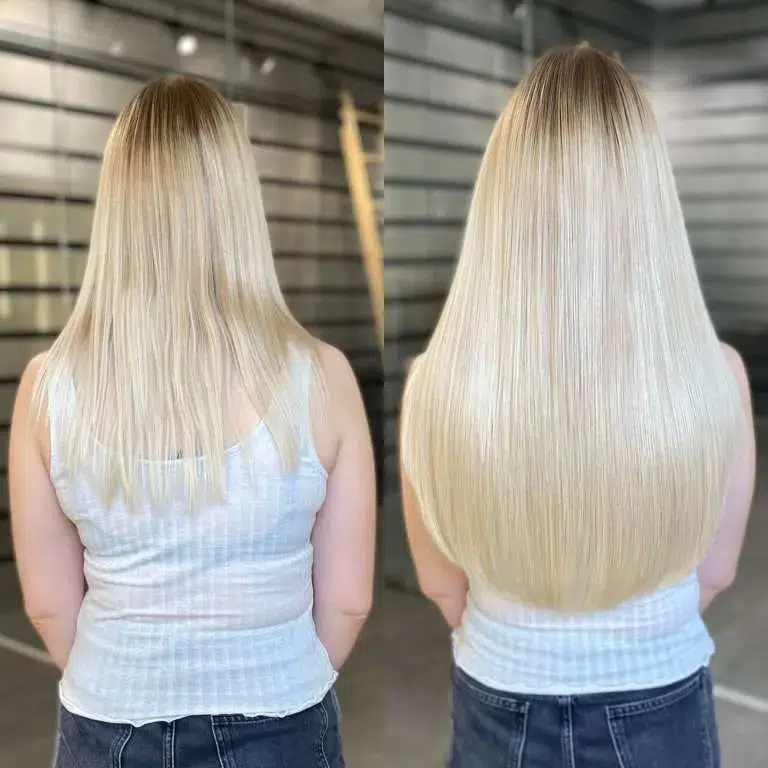
Yes, natural hair grows freely with micro links. Since there is no glue or heat blocking the follicle, the hair grows at its normal rate. Regular maintenance every 6 to 8 weeks is necessary to move the beads up.
I have seen many clients use micro links to grow out a bob haircut. It is the best method for this goal. Tape-ins cover a wide area of the hair. Wefts cover a whole row. Micro links leave 90% of the client’s scalp open to the air. This oxygen and blood flow are good for growth.
The “Move-Up” is Critical
The hair grows, but this creates a new problem. As the hair gets longer, the bead moves further away from the scalp.
- Week 1: The bead is 1cm from the scalp. Secure.
- Week 8: The bead is 3cm from the scalp. Unstable.
When the bead hangs low, the weight of the extension acts like a lever. It pulls on the root. If the client waits too long (like 12 weeks), the new growth will twist and snap.
Matting at the Root
The natural hair sheds every day. We lose about 50 to 100 strands a day. With extensions, these shed hairs are trapped inside the bead. They cannot fall to the floor. Over 8 weeks, that is a lot of shed hair. It forms a small cushion above the bead. During the maintenance appointment, you must open the bead and brush out this shed hair. If you do not, it turns into a dreadlock.
So, the hair grows perfectly fine, but only if the stylist manages the growth cycle.
Growth Timeline vs Maintenance:
| Time Frame | Hair Status | Action Needed |
|---|---|---|
| 0 – 4 Weeks | Fresh, secure. | Normal washing/brushing. |
| 4 – 6 Weeks | Slight growth, stable. | Schedule appointment. |
| 6 – 8 Weeks | Bead is low, potential twisting. | Move-up Appointment Essential. |
| 10+ Weeks | High risk of breakage/matting. | Damage control/Removal. |
Are micro links damaging?
Safety is the primary concern for luxury clients. You need to address fears about traction alopecia and breakage with honest, technical facts.
Micro links are one of the least damaging methods when installed correctly. Damage only occurs from improper application, such as taking too little hair, or client negligence, such as skipping maintenance. The method itself is safe.
I always tell my buyers: “Tools do not damage hair; bad hands damage hair.” In my 15 years in this industry, I have never seen a micro link bead damage hair by itself. It is simply a piece of metal and silicone. The damage comes from physics.
Cause 1: Too Much Tension
If a stylist installs the bead too close to the scalp, it pulls on the follicle constantly. This causes bumps, redness, and headaches. This is stylist error.
Cause 2: Overloading
I mentioned the ratio earlier. If you attach a 1-gram heavy strand to a thin wisp of baby hair, gravity will win. The natural hair will rip out. You must match density. This is why we offer different weights of strands at Hibiscus Hair.
Cause 3: DIY Removal
The worst damage happens when a client tries to take them out at home with pliers from the garage. They crush the bead the wrong way and cut their own hair. You must educate your client that professional removal is mandatory.
The Safety of Cold Fusion
Compare this to other methods.
- Glues: Can cause allergic reactions.
- Heat: Can scorch the hair cuticle.
- Sew-ins: Can be too heavy for fine hair.
Micro links avoid all these chemical and thermal risks. If the sectioning is clean and the client comes back every 6 weeks, their natural hair will remain 100% healthy.

My opinion
I produce tons of hair every year, and I see trends come and go. In my opinion, micro links—and specifically the new F-tip plastic nano extensions—are the gold standard for “hair health.”
However, the method is only as good as the hair you put in the bead. If you use cheap hair with stripped cuticles, the extension will tangle. When it tangles, the client pulls on it with a brush. That pulling causes the damage. You must use full cuticle, single-donor hair. The hair inside the bead must be soft and smooth. If the quality of the hair is poor, the best installation technique in the world cannot save you. Invest in the raw material first.
FAQ
Can I swim with micro links?
Yes, but you should tie your hair in a tight braid and apply a leave-in conditioner before swimming. Chlorine and salt water can dry out the hair. Wash it immediately after swimming.
Do micro links hurt?
They might feel tight for the first 24 to 48 hours, like a tight ponytail. After that, they should be painless. If there is sharp pain, a bead is pinching the skin and needs adjustment. F-tips generally hurt less than metal tips because they are flexible.
Can I use oil treatments?
You can use oil on the ends of the hair, but never on the roots. Oil makes the beads slip out.
How many packs do I need?
For a full head, you usually need 3 to 4 packs (150-200g). For just volume, 1 to 2 packs (50-100g) is enough.
Conclusion
Micro links are a skill-based, high-value service that offers your clients natural, damage-free length. If you master the installation and educate your clients on maintenance, you will build a loyal, profitable customer base.