Nano rings are often blamed for hair damage, but the ring itself is usually not the real problem. The real problem is poor sectioning, too much clamp pressure, wrong bead size, or late maintenance.
Nano rings are not automatically bad for your hair. They can be safe when the ring size, strand weight, section size, placement, and move-up timing match the client’s natural hair. They become damaging when the bead is over-crimped, placed too tightly, used on weak hair, or left in too long.
For salons, stylists, and hair extension buyers, the better question is not only “are nano rings bad for your hair?” The real question is whether the nano ring system is planned, installed, maintained, and sourced correctly.

If U treat nano rings like a precision method, U can keep them discreet and stable. If U treat them like a fast method, U can create tension, slip, and breakage. Below, I share how I suggest salons and buyers judge the method, so U can avoid complaints and protect repeat business.
What are nanos hair extensions?
Do U hear “nanos” and think it is a special hair material? Do U see suppliers label everything as “nano” and feel unsure what U are buying? I suggest U separate the method from the hair quality.
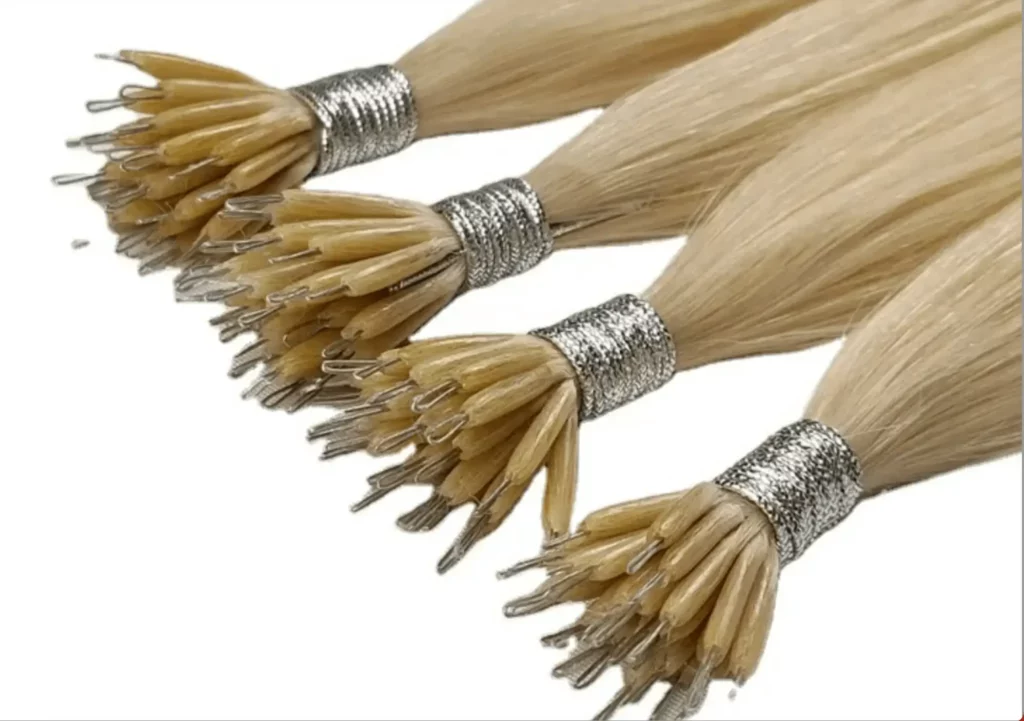
Nano hair extensions are usually I tip style strands that install with a very small bead. The “nano” part is the ring size and the matching nano tip, not the hair itself.
What “nano” really refers to
I suggest U explain nanos to clients as a system, not a single item. The system has three parts. The first part is the strand tip, often called a nano tip. The second part is the ring, which is smaller than a typical micro ring. The third part is the tool that closes the ring with controlled pressure.
I also suggest U clarify wording inside your team. Many people say “nano ring extensions” and “nano bead extensions” for the same method. Some brands use different metals or coatings. Some brands use silicone-lined rings. That difference changes slip risk and comfort.
What nanos are not
I do not suggest U sell nanos as “no damage” by default. I also do not suggest U call nanos “invisible” for every client. I suggest U treat nanos like fine hardware. The method works best when sizing and handling are correct.
Key components checklist
| Component | What it is | What I suggest U check as a buyer | Common risk if wrong |
|---|---|---|---|
| Nano tip strand | Pre-tipped strand for bead install | Tip shape, tip hardness, shedding control | Slip or hard edge friction |
| Nano ring / bead | Small metal ring, sometimes silicone-lined | Inner diameter, metal finish, lining quality | Breakage from pinching or corrosion |
| Closing tool | Pliers that clamp the ring | Jaw alignment, consistent pressure | Over-crimp and cuticle stress |
| Sectioning plan | Strand-to-section ratio | Hair density, pattern, tension map | Traction and weak root stress |
Are Nano Rings Good for Thin Hair?
Nano rings can work for some thin or fine-hair clients, but they are not automatically the safest choice for every thin-hair case.
The advantage is that nano rings are small and discreet. They can look cleaner than larger micro rings, especially around medium-density areas. They also avoid tape adhesive and heat, which some clients prefer.
But thin hair has less natural support. If the stylist uses too many strands, heavy tips, tight rows, or strong clamp pressure, nano rings can create tension and breakage.
| Thin Hair Planning Point | Better Practice | What to Avoid |
|---|---|---|
| Strand weight | Use lighter strands | Heavy standard-weight strands |
| Placement | Avoid fragile hairline and weak crown areas | Placing beads where hair is sparse |
| Bead choice | Smooth, small, possibly silicone-lined rings | Cheap rings with sharp edges |
| Maintenance | Book earlier move-ups, usually 6–8 weeks | Stretching wear time too long |
| Client expectation | Add natural density, not maximum volume | Promising thick-hair results on fine hair |
For thin hair clients, nano rings should be positioned as a small-bond option, not a no-risk method.
When Can Nano Rings Damage Hair?
Nano rings may damage natural hair when the system puts too much pressure on a small section of hair.
The most common problems are not caused by the nano method itself. They usually come from poor installation habits, low-quality beads, wrong strand weight, or clients wearing the extensions past the correct maintenance time.
| Damage Cause | What Happens | Salon Prevention |
|---|---|---|
| Over-crimped beads | The bead pinches or cuts into natural hair | Use controlled pressure and avoid flattening the bead |
| Sections too small | Too much weight pulls on too little hair | Match strand weight to natural hair density |
| Beads too close to scalp | Client feels soreness, tightness, or headaches | Leave enough movement space at the root |
| Poor bead finish | Rough metal edges create friction | Use smooth, well-finished rings |
| Late move-up | Grown-out beads twist, drag, and mat | Rebook maintenance every 6–10 weeks |
| Wrong client selection | Weak or shedding hair cannot support the system | Choose lighter methods or fewer strands |
This section is important for client education. It helps salons explain that nano rings are not “bad” by default, but they are not a careless method either.
How long do nano rings last in hair?
Do U want a clear cycle to plan rebooking and service pricing? Do U need a realistic answer for clients who ask, “How long will it last”? I suggest U use ranges, not one number.
Nano rings usually stay in hair about 6–10 weeks before a move-up. Some clients stretch to 12 weeks, but I suggest U avoid that on fine hair. Hair quality and aftercare decide reuse, not only the method.
Two different “lasting” questions
I suggest U separate two meanings.
- How long the install looks clean before it needs a move-up
- How long the extension hair can be reused across appointments
For the move-up cycle, growth speed, oil level, and density matter. For reuse, hair grade and tip stability matter. Full cuticle hair can handle multiple move-ups when the hair stays aligned and soft. Lower quality hair can tangle earlier, so reuse becomes risky.
What changes the cycle in real life
I suggest U watch these patterns.
- Oily scalp: slip shows up sooner.
- Weak night care: tangling near the root shows up sooner.
- High ponytails: tension points show up sooner.
- Fine hair: beads travel down faster and become visible faster.
Service planning table
| Client profile | Typical move-up | Why | What I suggest U tell clients |
|---|---|---|---|
| Fine hair, low density | 6–8 weeks | Beads show sooner, tension risk rises faster | Book early and keep strand count moderate |
| Medium density, normal scalp | 8–10 weeks | Balance of grow-out and concealment | Keep a steady routine |
| High density, strong hair | 8–12 weeks | Beads hide longer | Do not stretch if tangling starts |
| Oily scalp or gym lifestyle | 6–8 weeks | Slip risk rises | Use lined beads and strict aftercare |
Are nanos good for thin hair?
Do U serve clients with thin hair who want discreet bonds? Do U worry about tension and breakage claims? I suggest U treat nanos as a fit-for-purpose option.
Nanos can be good for thin hair because the bead is small and the bond can look discreet. Nanos can also be risky for thin hair if tension is high or maintenance is late. I suggest U plan lighter strands and tighter maintenance.
Why thin hair can benefit
I suggest U consider nanos when a client wants less bulk at the root. A smaller bead can help concealment. A no-heat method can also fit clients who avoid fusion heat. Nanos can also fit clients who react to tape adhesive.
Where thin hair gets into trouble
I suggest U remember one simple fact: thin hair has fewer strong fibers per section. If a stylist clamps a heavy strand onto a small section, the load concentrates. That creates traction. If beads are placed too close to the hairline, clients can see them. If beads sit on fragile crown areas, clients can feel them.
Thin-hair planning table
| Planning item | Best practice | Why it matters | What I suggest U avoid |
|---|---|---|---|
| Strand weight | Lighter strands per bond | Lowers tension per follicle | Standard weight on fine hair |
| Placement | Avoid fragile edges, stagger rows | Hides bonds and reduces traction | Straight lines that expose beads |
| Bead type | Smooth finish, optional silicone lining | Better grip with less pressure | Over-crimping to “make it hold” |
| Maintenance | Shorter move-up cycle | Stops bead drag and breakage | Stretching to 12+ weeks |
My view for salon positioning
I suggest U do not market nano rings as “safe for all thin hair.” I suggest U market them as “small-bond option when the plan is correct.” That message protects trust and reduces unrealistic expectations.
Nano rings vs micro rings: what is the real difference?
Do U see some suppliers call everything “micro” and others call everything “nano”? Do U want a simple way to explain the difference to buyers and clients? I suggest U focus on size and tolerance.
Nano rings are smaller than standard micro rings. That can improve discreetness, but it also reduces tolerance for sectioning errors. Micro rings are easier to handle, but they can look bulkier on fine hair.

What changes when the ring gets smaller
I suggest U train for cleaner sectioning with nano. A smaller ring needs a better match between natural hair amount and tip size. If the section is uneven, the ring clamps unevenly. That can cause slip or pinch.
A smaller ring also changes comfort. Some clients feel less bulk. Some clients feel more pressure if the ring finish is poor. That is why bead quality matters more in nano systems.

Nano Rings vs Micro Rings: What Is the Real Difference?
Nano rings and micro rings use a similar no-heat, bead-based installation idea. The difference is mainly bead size, visibility, handling tolerance, and client suitability.
Nano rings are smaller and more discreet. Micro rings are usually easier to handle and may give more grip on thicker hair.
| Factor | Nano Rings | Micro Rings |
|---|---|---|
| Bead size | Smaller | Larger |
| Visibility | More discreet | More visible on fine hair |
| Best for | Fine to medium hair when installed carefully | Medium to thick hair |
| Installation tolerance | Lower tolerance for sectioning mistakes | Slightly easier for beginners |
| Comfort | Can feel lighter when fitted correctly | Can feel bulkier on fine hair |
| Main risk | Slip or pinch if sizing is wrong | Bulk or tension if overused |
| Buyer check | Tip size and bead quality must match | Ring size and lining must match hair density |
For salons, nano rings are not simply “better” than micro rings. They are better only when the client needs a smaller, more discreet attachment and the stylist can control the installation details.
How do I prevent damage with nano rings?
Do U want fewer redo appointments? Do U want fewer complaints about soreness and breakage? I suggest U standardize the controls.
Damage prevention comes from pressure control, correct section size, smart placement, and on-time move-ups. I also suggest U choose smooth beads and stable hair quality.
Controls I suggest salons use during service
- I suggest U set a “no crush” rule for clamping.
- I suggest U match strand weight to section hair.
- I suggest U avoid heavy tension near edges and fragile zones.
- I suggest U book move-ups on time every cycle.
Controls I suggest salons teach in aftercare
- I suggest U keep conditioner away from root zones.
- I suggest U brush with support at the roots.
- I suggest U sleep with hair secured.
- I suggest U reduce heavy oils near beads.
Damage-prevention table
| Control point | What I suggest U do | What it prevents | What U can standardize |
|---|---|---|---|
| Clamp pressure | Use consistent force | Pinch breakage | Team training + same plier model |
| Section size | Match hair-to-strand | Traction and slip | Sectioning guide cards |
| Bead quality | Use smooth finish beads | Cuticle scraping | Approved accessory list |
| Move-up timing | Keep a strict cycle | Bead drag and matting | Auto rebook at checkout |
For Salons and Hair Brands: Why Product Quality Matters
Nano ring damage is not only an installation issue. Product quality also affects comfort, slippage, tangling, and repeat service results.
For salons, the biggest risk is not the first installation. The bigger risk is what happens after washing, brushing, sleeping, and moving up the extensions several times.
| Product Point | Why It Matters |
|---|---|
| Full cuticle hair | Reduces tangling and friction during wear |
| Consistent nano tip size | Helps stylists work faster and reduce slippage |
| Smooth bead finish | Lowers rubbing and scalp discomfort |
| Stable bead coating | Prevents color fading, roughness, or corrosion |
| Correct strand weight | Reduces stress on fine or fragile hair |
| Batch color consistency | Protects repeat salon orders and client trust |
Buyers should not judge nano ring extensions only by softness in the package. A real test should include washing, brushing, installing, removing, and checking whether the tip and bead still perform cleanly.For long-term softness and lower tangling risk, salons can also read our guide to full cuticle hair.
What should I check before I buy nano ring hair extensions wholesale?
Do U only test softness and shine in a sample pack? Do U also check tip size and ring finish? Before U scale orders, I suggest U check the system as a whole.
I suggest U check hair grade first, then tip consistency, then ring finish, and then batch stability. These checks protect your brand from shade mismatch, tangling, and client complaints.
%[nano ring hair extensions wholesale quality checklist full cuticle hair(https://placehold.co/600×400 “Factory QC scene: checking nano tips, ring plating, and hair alignment under light”)]
Hair and tip quality checks
I suggest U check if the hair is full cuticle and aligned. I suggest U wash the hair sample, not only touch it dry. That reveals coating tricks. I suggest U check if nano tips feel smooth and stable. I suggest U check if tip sizes are consistent, because mixed sizes slow work and increase slip risk.
Ring and accessory checks
I suggest U check plating quality and edge smoothness. I suggest U check silicone lining stability if U use lined beads. I suggest U check if ring color matches client hair, because shine can expose bonds.
Supplier evaluation table
| Check item | What I suggest U ask for | What U should look for | Why it matters |
|---|---|---|---|
| Hair grade | Source and process notes | Low tangling after wash | Reuse and client satisfaction |
| Tip consistency | Size spec and tests | Even tips across bundles | Faster installs, fewer slips |
| Ring finish | Material and plating | Smooth edges, stable color | Less cuticle stress |
| Batch control | Shade cards and policy | Stable tones over time | Brand stability for salons |
| Claims support | Clear terms | Practical troubleshooting | Protects reputation |
My View
I do not see nano rings as a damaging method. I see them as a precision method.
When the bead, tip, section, strand weight, and clamp pressure are controlled, nano rings can give a clean and discreet result. But they leave very little room for careless work. A small bead does not forgive poor sectioning or rough removal.
For salons, the safest approach is to treat nano rings as a system: hair quality, bead quality, tool pressure, placement map, and maintenance schedule all need to work together.
For wholesale buyers, I would not test only the hair. I would test the nano tip, the bead finish, the grip, the removal process, and the hair behavior after washing. That is where many future complaints can be prevented.
FAQs About Nano Rings and Hair Damage
Are nano rings bad for your hair?
Nano rings are not bad for hair when installed correctly. Damage usually happens when the bead is too tight, the section is too small, the strand is too heavy, or maintenance is overdue.
Do nano rings cause hair loss?
Nano rings can contribute to breakage or traction stress if they are installed with too much tension. They should not cause hair loss when the client is suitable and the move-up schedule is followed.
Are nano rings good for thin hair?
Nano rings can work for some thin-hair clients because the beads are small and discreet. But the install must be lightweight, carefully placed, and maintained earlier than thicker-hair installs.
How long do nano rings last in hair?
Most nano ring installations need maintenance every 6–10 weeks. Fine hair, oily scalps, and active lifestyles may need move-ups closer to 6–8 weeks.
Why do nano rings slip?
Nano rings may slip if the section is too large, the bead is not clamped correctly, the ring lining does not match the client’s hair, or oily products are applied near the roots.
Are nano rings better than micro rings?
Nano rings are smaller and more discreet, while micro rings are usually easier to handle on thicker hair. The better choice depends on hair density, visibility needs, stylist skill, and bead quality.
Conclusion
Nano rings are not automatically bad for your hair. They become risky when the installation is too tight, the bead is over-crimped, the section is wrong, or the client waits too long for maintenance.
For the right client, nano rings can be discreet, comfortable, and useful for no-heat strand-by-strand work. For fine or fragile hair, the plan must be lighter and more careful.
For salons and hair extension buyers, the safest result comes from good hair quality, smooth beads, consistent nano tips, correct placement, and honest client aftercare. You can contact Hibiscus Hair to request nano ring extension samples, bead matching support, or wholesale recommendations.For sample testing, color matching, or wholesale planning, you can contact Hibiscus Hair for nano ring extension recommendations.