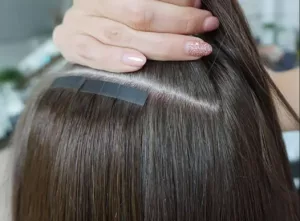
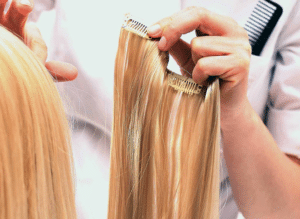
A hand tied install can look perfect in the chair. Then the client goes home and the weft starts poking out. That one detail can ruin the whole blend and trigger complaints.
Hand tied extension sticking out usually happens because the row sits too high, the weft is too thick for the section, the client has fine density, or the finish work is not locking the top layer. The fix is almost always placement, tension balance, and a cleaner blend plan.

If you are a salon owner or stylist, you need a checklist you can repeat. Below is the real-world troubleshooting path that protects both the client’s comfort and your retention.
Why hand tied extension sticking out?
When a client says “my weft is showing,” they often mean two things. The band is visible. Or the hair flips and exposes the track when they move. Both problems have clear causes.
Hand tied extension sticking out is caused by row placement that fights the client’s growth pattern, too much weft weight on one row, poor tension distribution on the bead line, or not enough natural hair left on the top to act as a cover. Fixing it starts with identifying which of these is happening.
Dive deeper
This issue is not random. A hand tied weft is thin, but the row still has structure. That structure can push out when the head moves. A client also touches hair more at home. They tuck behind the ear. They tie a ponytail. They sleep and roll. So the track is tested in ways the salon chair does not show.
1) Placement and head shape
A row that is placed too high at the parietal ridge tends to flip out. A row that is too close to the hairline also tends to show. A row that curves wrong on the occipital bone can create a “corner lift.” So the weft looks like it is sticking out even if the hair is quality.
2) Too much weft weight per row
Stylists often stack too much volume on one line to save time. That creates bulk. Bulk pushes the cover hair up. Then the top layer separates and the band peeks out. This happens more on fine hair and on short-to-medium hair.
3) Bead tension and spacing
If bead tension is uneven, the row can “hinge.” The hinge point sticks out first. If beads are too far apart, the weft can bow. If beads are too tight, the client feels pain and they move hair constantly, which exposes the row.
4) Not enough cover hair
Some heads need more leave-out than others. If the client has thin density, the cover layer must be planned. If the cover layer is too thin, it will split and reveal the weft.
Quick diagnosis table
| What you see | What it usually means | What to check first | Typical fix |
|---|---|---|---|
| band visible when hair parts | not enough cover hair | top section density | adjust section + add topper strategy |
| weft peeks when client moves | placement conflict | parietal/occipital curve | re-map row curve |
| corners lift | bead spacing or curve | end bead position | add support bead or adjust curve |
| row feels bulky | too much weft | weft count per row | reduce weft load, add second row |
The fastest win comes from diagnosis, not from adding more hair.

Is the row placed too high or too close to the hairline?
This is the most common reason a track shows, especially on fine hair or on clients who wear their hair up often. A high row also makes the weft fight gravity, so it flips out.
A row placed too high or too close to the hairline makes hand tied extension sticking out more likely because the cover hair is weaker there and the head shape changes fast. The fix is a new row map with safer “no-show” zones.
Dive deeper
A good hand tied map respects three things. It respects the client’s part line. It respects density changes. It respects movement points on the head.
Key zones that cause show-through
- The temple area has light density and strong movement.
- The parietal ridge is where hair flips over.
- The nape has short hair and can expose beads if too low.
- The crown swirl can open gaps if rows cross it.
A practical mapping method
A stylist can do a simple test before install:
- Ask the client to shake hair left and right.
- Ask the client to tuck behind both ears.
- Ask the client to lift hair into a mid ponytail.
- Watch which areas open first.
Those areas are not safe for a high row. Those areas need more cover hair or a different method.
When a lower row works better
A lower row gives more cover hair and more stability, but only if the nape hair can hide the line. Some clients have short nape layers. Those clients need a slightly higher nape row and lighter weft load.
Row placement guide table
| Client factor | Risk of weft showing | Placement note |
|---|---|---|
| fine density | high | keep rows lower and lighter |
| strong side part | medium | map to part line, avoid crossing it |
| short layers | high | leave more perimeter out, reduce bulk |
| active lifestyle | medium | plan for ponytail testing |
If the row is wrong, no amount of styling will make it “stay hidden” long term.
Are you overloading the row with too much weft?
A hand tied weft is thin, but stacking still creates bulk. Bulk changes the fall of the top hair. That makes the weft edge pop out. Many salons see this after a few days, not on day one.
Overloading happens when too many wefts are placed on one row, or when a thick bundle is used on a client who needs lighter distribution. The correction is to spread weight across rows, reduce weft count, or use a finer weft option.
%[too many wefts causing hand tied row bulk(https://placehold.co/600×400 “overloaded hand tied row”)]
Dive deeper
A stylist often tries to hit a “full” result with fewer rows. That can work on dense hair. That fails on fine hair. A row that is too heavy creates a ridge. That ridge pushes the top hair away. Then the client sees the track.
Signs of overload
- The row looks raised even when the hair is flat.
- The client feels the row when they touch the head.
- The hair does not fall smooth at the root.
- The weft edge is visible in photos with flash.
How to distribute weight better
- Add a second row instead of stacking more on one row.
- Use shorter weft pieces where density is low.
- Avoid stacking thick bundles at the sides.
- Balance left and right so the row sits even.
Overload prevention table
| Goal | Bad move | Better move |
|---|---|---|
| more fullness | stack extra weft on one row | add second row with lighter load |
| more length | use heavy long wefts only | blend with length + density match |
| seamless sides | add bulk near temple | keep sides light, use shorter pieces |
A clean install usually has more planning, not more hair.
Is the stitching or fold technique creating a hard edge?
Even with perfect placement, the weft can stick out if the edge is too firm. Some fold techniques create a thick corner. Some stitching patterns create “hinge points” that flip.
A hard edge is created by bulky folds, tight return stitches at the corners, or using the wrong thread tension. The fix is a flatter fold plan, cleaner corners, and stitch spacing that supports without building a ridge.
%[hand tied weft fold and stitch technique for flat finish(https://placehold.co/600×400 “flat weft stitching”)]
Dive deeper
Most clients do not know what stitching is. They only see the result. So a stylist needs to control every detail at the corners.
Corner management
Corners are the first to show. A thick folded corner acts like a small bump. That bump lifts the cover hair. A cleaner approach is to keep corners flat and use shorter weft segments when needed.
Thread tension
Thread tension should secure the weft, but it should not cinch the weft into a rope. Rope-like tension creates a ridge. That ridge sticks out. A balanced tension keeps the row flexible.
Stitch pattern logic
A stitch pattern should support the weft evenly. If the stitch points are too far apart, the weft can bow. If the stitch points are too tight, the row becomes stiff.
Technique table
| Technique issue | What it causes | Better option |
|---|---|---|
| thick fold corner | corner lift | flatter fold or cut weft segment |
| tight return stitch | hinge point | softer return + balanced tension |
| wide stitch gaps | weft bowing | closer support points |
| over-sewn row | stiff ridge | reduce stitches, keep flexible |
This is why hand tied results vary by salon. The hair can be premium, but the finishing can still fail.

Is the client’s hair too fine or too short for the current plan?
Some hair types will show tracks easier. Fine hair separates. Short hair has less coverage. Blunt cuts can expose the row when hair moves. This is not a “bad client.” This is a planning issue.
Fine or short hair needs a lighter, more strategic row plan with more leave-out and less bulk per row. Some clients also need a hybrid plan, like mixing weft with another method for the perimeter.
%[hand tied extensions for fine hair coverage strategy(https://placehold.co/600×400 “fine hair hand tied coverage”)]
Dive deeper
A stylist should match the method to the head. Hand tied works well for many clients, but not all clients can hide a weft the same way.
Fine hair realities
Fine hair has less “shadow coverage.” It shows lines easily. Fine hair also gets oily faster at the root, and that can separate strands and expose the row.
Short hair realities
Short hair has less length to drape over the track. If the client has a blunt bob, a weft can show when the ends move. A stylist can still do wefts, but the row must be lower and lighter. The blend cut must be planned.
A better consultation checklist
- Density at crown and sides
- Client’s daily styling habits
- Updo needs
- Scalp oil level
- Layer length at the perimeter
Suitability table
| Client profile | Risk of sticking out | Planning adjustment |
|---|---|---|
| very fine hair | high | lighter weft, more rows, more leave-out |
| short blunt hair | high | low row + blend cut + less bulk |
| medium density | medium | standard mapping works |
| thick density | low | more tolerance, still avoid overloading |
If the hair type needs a different plan, the best fix is a redesign, not a quick cover-up.
Is aftercare and styling exposing the weft?
Sometimes the install is fine, but daily habits expose it. A client can brush wrong, sleep with wet hair, or use heavy oils at the root. That can separate the cover hair and show the weft.
Aftercare affects visibility because it controls root direction and separation. The solution is simple education: how to brush, how to sleep, and how to style without pulling the cover hair away from the row.
Dive deeper
Clients often do not know what “normal” feels like after install. They touch the row. They flip hair. They pull it into tight styles. Those actions can expose the track.
Common habits that cause show-through
- Tight ponytails that lift the cover layer
- Brushing straight down at the root without supporting the row
- Sleeping without a braid or silk bonnet
- Applying oil or conditioner near the root
- Letting sweat and salt build up at the row
What a salon can teach in 60 seconds
- Brush ends first, then mid, then root.
- Hold the hair above the row when brushing.
- Sleep in a loose braid or low ponytail.
- Keep conditioner away from the root area.
- Book maintenance before the row grows out too far.
Aftercare table
| Habit | What it does | Better habit |
|---|---|---|
| tight high ponytail | lifts cover hair | low loose ponytail |
| root oiling | separates top hair | oil mids/ends only |
| rough brushing | pulls cover hair | support + gentle strokes |
| overdue move-up | shifts row | keep schedule |
A salon that teaches this reduces complaints and keeps rebook rates strong.

My opinion
Hand tied extension sticking out is usually a planning problem, not a hair problem. I see the best long-term results when a salon uses lighter weft load, smarter mapping, and clear aftercare rules. A quick “add more hair to cover it” fix usually creates more bulk and more show-through later.
FAQ
Why are my hand tied weft extensions showing on the sides?
Sides have lower density and more movement. A row that is too high, too heavy, or too close to the temple will show faster. A lighter side plan and better mapping usually fixes it.
Can poor hair quality make a hand tied weft stick out?
Poor quality hair can tangle and create separation, which can expose a row. But most “sticking out” issues are placement, tension, or bulk issues.
How soon can a client notice a weft sticking out?
It can happen the same day, but it often shows up after the first wash, sleep, or ponytail because the hair moves and separates in real life.
Does thick thread or over-sewing cause bulk?
Yes. Heavy thread tension and dense stitching can create a ridge. A flatter stitch plan often improves the lay.
Should a salon add another row to fix sticking out?
Sometimes. Adding a row can reduce bulk on one line. But adding a row without changing mapping can make the issue worse. A redesign is better than stacking.
Can a client style hair to hide a row that is sticking out?
Styling can hide it short-term, but the root cause stays. A salon adjustment is the real fix.
Conclusion
A hand tied weft sticks out because of placement, bulk, tension, or low cover hair. A stable row map, lighter distribution, and clean finishing usually solves it fast.