Did your I tip extensions look great at first, then you started finding little strands on your clothes? Did you feel that small “click” in your stomach when you saw a bead slide down? Are you wondering if you did something wrong, or if the install was not right?
I tip extensions fall out when the bead grip loosens, the natural hair section is not balanced, or oils and product buildup reduce friction. Slipping also happens when beads are too large, not clamped well, or when you brush and sleep in ways that pull on the bead. You can fix most fallout by spotting the failure type first, then adjusting care and maintenance.

If you are reading this because you feel stressed, I get it. You paid for a service. You also invested your time. So you deserve clear answers. I will walk you through the most common causes, and I will show you what you can check at home before you book a fix.
Is it slipping, shedding, or breakage?
When you say “my I tip extensions are falling out,” what do you really mean? Are whole I tip strands coming out with the bead still attached? Are you seeing a lot of loose hairs, but the beads stay in place? Or are you seeing short broken hairs near the root?
You need this step first because each situation has a different solution. If you treat shedding like slipping, you may push for tighter beads and cause damage. If you treat slipping like shedding, you may ignore a real install issue.
What you can check in 60 seconds
You can pick up a fallen strand and look at it closely. You can also check your scalp area where it came from.
| What you see | What it usually means | What you should do next |
|---|---|---|
| The bead is still attached to the extension and the whole piece is out | Slipping or bead release | Book a bead check and review oil/products |
| The extension hair sheds from the strand but the bead stays | Extension shedding | Ask about hair quality and handling |
| Short broken natural hairs are stuck in the bead | Breakage from tension | Ask to reduce tension and adjust placement |
| The bead slid down on your hair before it came off | Bead loosening | Plan a maintenance move-up sooner |
| The bead feels sharp and pulls | Compression issue | Ask for bead type change or smoother beads |
Why this happens with I tip specifically
I tip methods depend on mechanical grip. That grip is not permanent. Your natural hair grows. Your scalp produces oils. Your daily motion creates micro-movement. All of that can reduce friction over time. So your goal is not “never move.” Your goal is stable grip plus safe maintenance.
A quick personal note
When I first started learning this category, I assumed “falling out” was one problem. Then I saw three different failure types in one week. That changed how I advise people. I always start with diagnosis now.

Are the beads the wrong size, type, or installed poorly?
Have you ever noticed that your beads look bigger than you expected? Did your scalp feel bulky or itchy right after the service? Did you hear a faint “ticking” sound when beads moved during brushing? These small signs often point to bead selection or bead closing problems.
If the bead is too large, it can slide. If the bead is too small, it can pinch and cause breakage. If the bead has a rough inner edge, it can grind your hair. If the bead is not clamped flat and firm, it can open slowly.
What bead issues look like in real life
You might feel beads “traveling” down. You might see beads sitting at odd angles. You might also find that fallout happens in one area more than others, like the nape or around the hairline.
| Bead issue | What you might notice | Why it leads to fallout | What you can ask for |
|---|---|---|---|
| Bead too large | Beads slide down fast | Weak friction on hair | Smaller bead or better match to section |
| Bead too small | Soreness, breakage | Hair is over-compressed | Slightly larger bead or less tension |
| Poorly clamped bead | Bead opens over time | Grip loosens with movement | Re-clamp with correct tool pressure |
| Bead not aligned | Bead sits sideways | Uneven grip and pulling | Reposition and clamp flat |
| Rough inner surface | Itchy, tangling near bead | Hair gets abraded | Smoother beads or lined beads |
How you can talk to your stylist without sounding demanding
You can say: “Can you check if the bead size matches my hair thickness?” You can also say: “Can you show me one bead that you think is correctly closed?” A good stylist will not be offended. They will be happy you care.
What you should not do at home
You should not clamp beads yourself with random pliers. You can crush your hair. You can also create sharp edges. If a bead feels loose, you should book a quick adjustment.
Is your natural hair section too thick or too thin?
Do you feel like some strands feel heavy, while others feel loose? Do you see some beads holding fine, but others sliding? That pattern often comes from sectioning.
I tip needs a clean balance. The extension strand weight must match the amount of your natural hair inside the bead. If the section is too thick, the bead cannot fully grip every hair. If the section is too thin, your hair holds too much load, so it breaks.
The sectioning problems that create fallout
- Thick sections make slipping more likely
- Thin sections increase tension and breakage risk
- Uneven sections create mixed results across the head
| Section outcome | What you might notice | What it indicates | What to request at the next appointment |
|---|---|---|---|
| Clean slip with little hair attached | Pieces fall out easily | Section too thick or oily root | Smaller sections and better prep |
| Short broken hairs in bead | Hair snaps near root | Section too thin or too heavy strand | Lighter strand size and safer placement |
| Cluster fallout in one zone | Same area fails | Placement and section pattern | Re-map rows and re-balance |
| Beads twist easily | Beads rotate | Uneven hair distribution | Better alignment and consistent parts |
A simple question you can ask yourself
Ask: “Is my natural hair fine, medium, or thick?” If your hair is fine, you usually need smaller strands and smaller beads. If your hair is thicker, you can handle slightly larger sections. This is not about “better” hair. It is about matching.
Why this matters before you re-install
If you reinstall without fixing section balance, you repeat the same failure. Then you feel like I tip “does not work for you.” But often, the method is fine. The match is off.
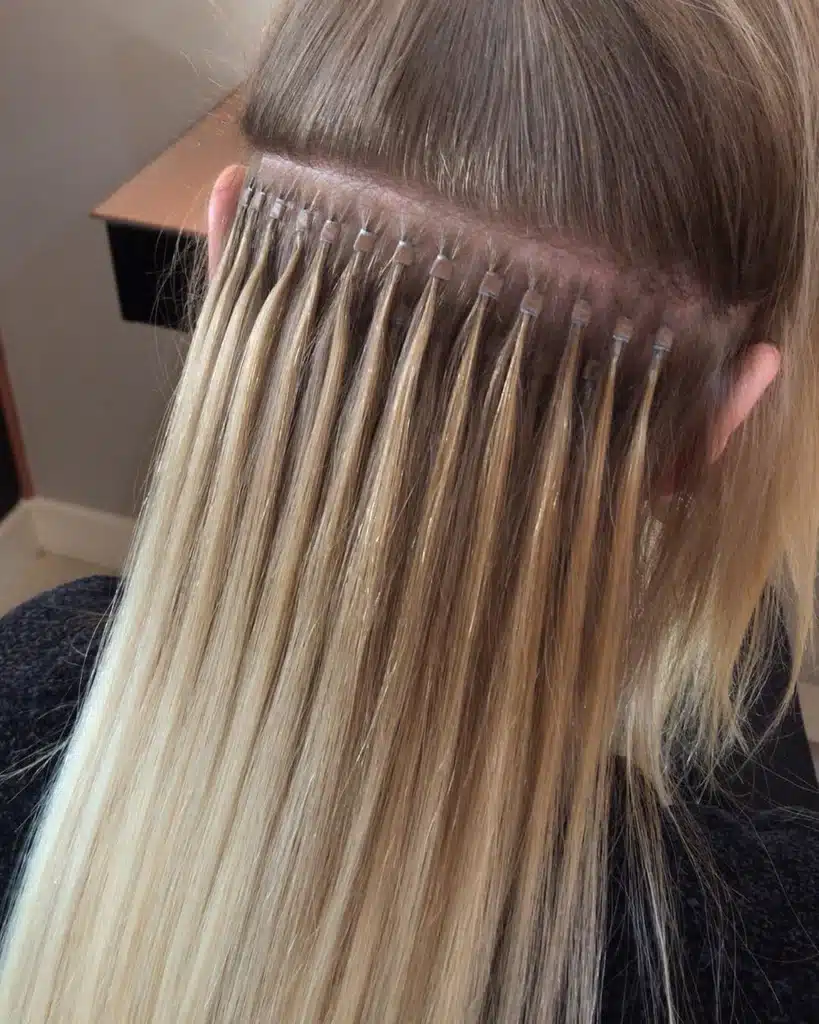
Are oils, conditioner, and scalp products making the beads slip?
Let me ask you directly. Do you use hair oil near your scalp? Do you use leave-in sprays on the root area? Do you put conditioner too high because you want softness? Do you love dry shampoo?
All of those can reduce grip. Beads depend on friction. Oil reduces friction. Silicone can make hair too slippery. Product residue can also build up around the bead and make it shift.
%[i tip extensions slipping from oil buildup(https://placehold.co/600×400 “i tip extensions slipping from oil and buildup”)]
The most common product habits that cause slipping
- Scalp oil or growth serums near beads
- Conditioner dragged across beads during rinsing
- Silicone sprays used at the root
- Heavy mask applied too close to the scalp
- Dry shampoo used repeatedly without full cleanse
| Product habit | What you may notice | Why it causes fallout | What to change |
|---|---|---|---|
| Oil near scalp | Beads slide sooner | Friction drops | Keep oil mid-length to ends only |
| Conditioner on roots | Slipping after wash day | Beads get coated | Apply conditioner below bead line |
| Silicone sprays | Hair feels too slippery | Grip weakens | Avoid root sprays, use on ends only |
| Heavy masks | Beads feel greasy | Residue builds | Use masks only on lengths |
| Dry shampoo layering | Itchy scalp, dull roots | Buildup around beads | Use less and do a deeper cleanse |
What you can do without over-washing
You can focus shampoo on the scalp. You can rinse well. You can keep conditioner lower. You can also use a gentle clarifying wash sometimes if buildup is heavy. If you have hard water, you may need a chelating wash now and then.

Are brushing, sleeping, and workouts pulling on the beads?
Do you brush fast when you are in a hurry? Do you sleep with your hair loose? Do you go to the gym and let sweat dry at the root? Do you sometimes sleep with damp hair?
These are everyday habits. But with I tip, small pulling forces add up. Beads can slowly loosen. Hair can tangle near the bead and create a “lever” that pulls.
%[i tip aftercare brushing sleeping workouts(https://placehold.co/600×400 “i tip aftercare brushing sleeping workouts”)]
The habits that most often create loosening
- Brushing without holding the root area
- Brushing from top to bottom in one strong pass
- Sleeping with hair loose and rubbing on pillow
- Sweat and salt buildup near the root
- Wearing tight ponytails that pull on beads
| Habit | What it does | What you can do instead |
|---|---|---|
| Rough brushing | Twists and loosens beads | Hold roots and brush slowly in sections |
| Sleeping loose | Causes friction and tangles | Use a loose braid or low ponytail |
| Wet hair sleep | Tangles near beads | Dry roots before bed |
| Heavy workouts | Salt weakens grip over time | Rinse scalp and dry after workouts |
| Tight styles daily | Creates constant tension | Rotate styles and keep them gentle |
A small routine that helps most people
You can do three things. You can brush in sections. You can hold the root area with your fingers while brushing. You can secure hair for sleep. If you do that for two weeks, you usually see less slipping.
Are you overdue for maintenance and move-up?
When was your last move-up? Was it 6 weeks ago? Was it 10 weeks ago? If you cannot remember, that may already be the answer.
I tip extensions need maintenance because your hair grows. As hair grows, the bead moves away from the scalp. Then it has more room to twist and slide. Then tangles form closer to the bead. That creates pulling and loosening.
%[i tip move up schedule maintenance(https://placehold.co/600×400 “i tip move up schedule and maintenance”)]
What happens when you wait too long
- Beads drop lower and twist more
- Tangles form and create tension
- The bead grip weakens from motion
- Fallout increases in the nape and sides
| Maintenance timing | What you might notice | Risk level | What you should do |
|---|---|---|---|
| 4–6 weeks | Small growth, stable | Low | Routine check if needed |
| 6–8 weeks | More movement | Medium | Book move-up for stability |
| 8–10+ weeks | Tangling and slipping | High | Book move-up ASAP |
What you can do if you are busy
You can book a short “bead check” appointment first. A good stylist can tighten or re-clamp a few problem beads and plan a full move-up. This is better than waiting until many pieces fall out.
Is the extension hair quality causing shedding that looks like fallout?
Sometimes you think extensions are “falling out,” but the bead is still there. The issue is that the extension hair sheds from the strand. That can happen when the hair is not processed well, or when the return hair is weak, or when the strand construction is not stable.
High-quality full cuticle hair usually sheds less because the cuticle alignment stays stable. Lower quality hair can tangle more, then shed more during brushing. That feels like “fallout,” even though the bead did not fail.
%[i tip extension shedding hair quality(https://placehold.co/600×400 “i tip extension shedding vs bead slipping”)]
How you can tell shedding from bead failure
If the bead is still on your head and the strand looks thinner over time, that is shedding. If the whole strand and bead are gone, that is slipping or release.
| What you observe | Likely cause | What to do |
|---|---|---|
| Beads stay, strand gets thinner | Hair shedding | Ask about hair grade and construction |
| Tangling gets worse, then shedding rises | Hair quality and cuticle issues | Improve hair care and consider better hair |
| Shedding mainly after harsh brushing | Handling damage | Change brush method and reduce force |
| Shedding starts right away | Production issue | Contact provider and request evaluation |
My view as a manufacturer
I focus on full cuticle, single donor hair because it stays smoother for longer. Smooth hair tangles less. Less tangling reduces aggressive brushing. That chain often reduces perceived “fallout” for end users.
My opinion
I think I tip fallout becomes less scary when you break it into simple categories. You can ask: “Did it slip, did it shed, or did it break?” You can then look at the bead, your natural hair, and your routine. I also think many clients get the method without a clear aftercare plan. So they do normal things, like using oils at the root, or sleeping with wet hair, and they do not know it affects bead grip. If you want I tip to feel worth it, you need two things. You need correct bead and section matching at install. You also need steady maintenance and simple daily habits. If you feel unsure, you should bring 5–10 fallen pieces to your stylist and ask for a failure check. You should not just reinstall and hope.

FAQ
Why are my I tip extensions falling out after 2 weeks?
This often points to slipping from oily roots, product residue, loose clamping, or sections that are too thick. You can check the fallen piece. If there is little or no natural hair attached, slipping is likely.
Is it normal for a few I tip strands to fall out?
A small amount can happen, but repeated fallout is not normal. If you see a pattern, you should book a bead check.
Can oil make I tip extensions slip?
Yes. Beads rely on friction. Oil reduces friction. You can keep oils and serums away from the bead area.
Why do my beads slide down?
Beads slide when grip weakens. That can come from oil, buildup, bead size mismatch, or overdue move-up.
Why do my I tips feel itchy?
Itch can come from buildup, beads touching the scalp, rough bead edges, or tension. You can ask your stylist to check bead type and placement.
Can I swim with I tip extensions?
You can, but you should protect the hair. You should rinse after swimming. You should dry the root area. Chlorine and salt can increase tangling.
How often should I do a move-up for I tip?
Many people need a move-up around 6–8 weeks, but it depends on hair growth and routine. If beads twist and tangle, you are likely overdue.
Why do I see short broken hairs in the bead?
That often points to tension or too thin sections. You can ask for lighter strand sizes and safer placement.
Why is fallout worse at the nape?
The nape has more friction from collars and pillows. It also tangles easily. Maintenance timing matters a lot in this zone.
Can I fix a loose bead at home?
You should not clamp beads with random tools. You can damage your hair. You should book a quick adjustment instead.
Conclusion
Your I tip extensions fall out for clear reasons. You can identify the failure type, then fix bead grip, section balance, product habits, and maintenance timing. This gives you stable wear and safer hair.