Have U ever heard someone say “nano links are the smallest bead extensions”? Do U want to know what that really means before U spend money on hair, tools, or a salon appointment?
Nano link extensions are a type of strand-by-strand hair extension that uses a tiny bead (a nano ring) to clamp an extension strand to your natural hair. The method uses no glue and no heat. Nano links can look very subtle because the bead is small, but results still depend on good fitting, careful sectioning, and regular move-ups.

This article is a simple guide for anyone who is curious about nano link extensions. U do not need to be a stylist to follow it. I will explain what they are, what is good about them, what is not so good, and what controls the final result.
What are nano link hair extensions?
Do U see “nano links,” “nano rings,” and “nano beads” online and feel confused? Many people use these words in different ways, so I will keep it simple.
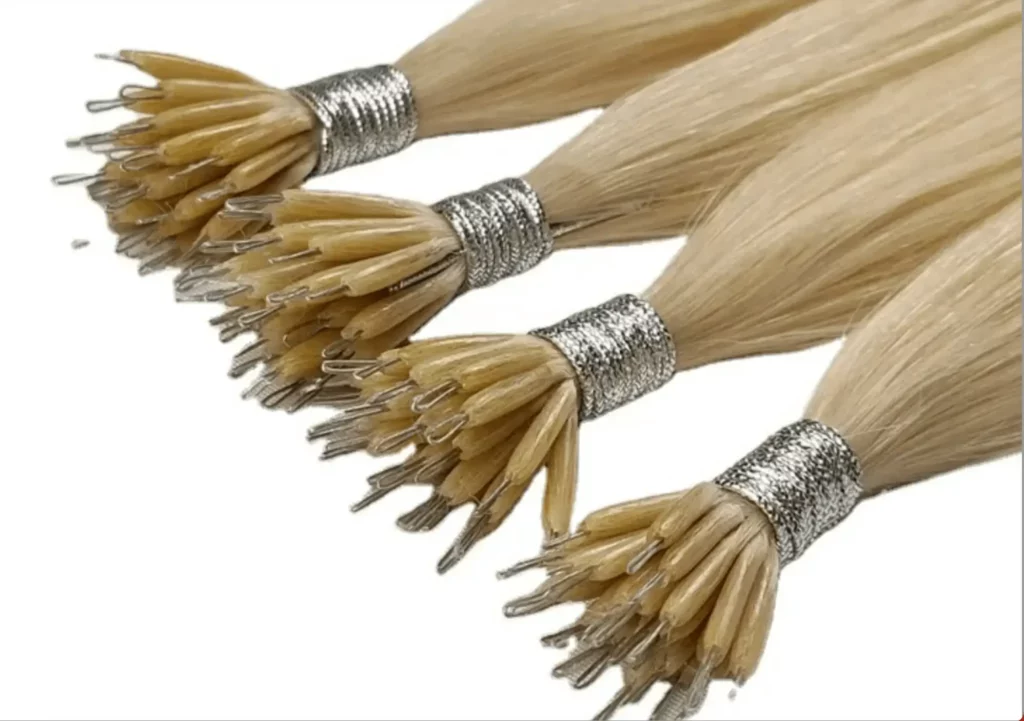
Nano link hair extensions are hair extensions attached with a very small metal bead. The bead holds your natural hair and one extension strand together by clamping them. Most nano link systems use nano tip strands, which are designed to fit the smaller bead.
Dive deeper
Nano links belong to a bigger family called bead extensions. In this family, the idea is always the same. A stylist takes a small section of your hair. The stylist puts that hair section through a bead. The stylist inserts the extension strand into the same bead. Then the stylist clamps the bead closed with pliers. That is the whole “technology.” It is mechanical, not chemical.
People often ask if nano links are a totally different method. They are not. Nano links are a smaller version of micro links or micro beads. The “nano” part mainly means the bead is smaller. Because the bead is smaller, it can look less bulky in the hair. This is why many people like the idea of nano links.
Still, smaller also means less room for mistakes. The bead has less space inside. So the tip size and the bead size must match. In most salons, nano beads are paired with nano tip hair strands. Micro beads are usually paired with I tip hair strands. This is important because wrong matching can cause problems. If the bead is too big for the tip, grip can be weaker and slipping can happen. If the bead is too small for the tip, the bead may not close correctly and pressure can rise.
Nano links also depend on where they are placed. Even a small bead can show if it sits right under a part line. Even a small bead can feel uncomfortable if it sits too close to the scalp. So “nano” does not automatically mean “perfect.” It only means the hardware is smaller.
| Term U may see | What it usually means | Key thing to remember |
|---|---|---|
| Nano links | Small bead extension method | Usually uses nano tip strands |
| Nano rings / nano beads | The tiny bead hardware | Bead size must match tip size |
| Micro links / micro beads | Bigger bead extension method | Usually uses I tip strands |
What are the advantages of nano link hair extensions?
Do U want extensions that do not use glue or heat? Do U want a method that can look subtle when done well?
Nano links can feel light, look discreet, and avoid adhesive. The bonds can also be moved up during maintenance, which can help with reuse when the hair quality is high.
Dive deeper
One advantage is the “no glue, no heat” part. Some people worry about adhesive residue or heat exposure. Nano links do not rely on those. The bond is a bead clamp, so the method can feel cleaner in that sense.
Another advantage is discreetness. A smaller bead can reduce the chance that bonds look bulky. This can be helpful for people with fine to medium hair who often struggle with visible bonds.
Another advantage is that move-ups are possible. Your hair grows. When it grows, the bond moves down. A stylist can open the bead, move the strand up, then close it again. This is why many people say bead methods are “maintenance friendly.” Still, that depends on the condition of the extension strand and the tip area after wear.
Nano links can also suit people who want flexible styling. Bead methods usually allow normal hair movement. Some people prefer this feel compared to larger tape panels or bulky wefts, but the best choice always depends on your hair type and your lifestyle.
One more advantage is choice. Nano links can be used in smaller, targeted areas for volume, not only for length. Many people do not need a full head. They only need support in the sides or back. A bead system can be designed in a modular way.
| Advantage | Why people like it | What makes it work well |
|---|---|---|
| No glue and no heat | Fewer chemical concerns | Good bead finish and fit |
| Small bond look | More discreet blending | Correct placement and color match |
| Move-up possible | Helps long-term wear | Regular maintenance schedule |
| Flexible feel | Natural movement | Correct section size and spacing |
What are the disadvantages of nano link hair extensions?
Do U worry about slipping? Do U worry about damage? Nano links can be safe, but they are not “risk free.”
Nano links can slip if the section size is wrong. Nano links can cause stress if the bead is clamped too hard. They also need regular move-ups because grow-out can create tangles and pulling.
Dive deeper
The biggest disadvantage is that nano links need precision. The bead is small. That means the amount of your natural hair inside the bead must be correct. If there is too much hair, the bead cannot clamp evenly. The strand can slide. If there is too little hair, the bond can pull and feel tight.
Another disadvantage is pressure mistakes. Some people think tighter is always better. That is not true. Over-crimping can create sharp edges. It can also crush the hair inside the bead. Over time, this can lead to breakage near the root. This is why the skill of the installer matters a lot.
Another disadvantage is maintenance. Nano links are not “install and forget.” If your hair grows out and the beads sit too low, they can start to drag. Drag can cause tangling near the roots. Tangling can lead to strong brushing. Strong brushing can lead to stress and breakage. So move-ups are part of the method.
Another disadvantage is bead visibility in the wrong situation. Nano beads are small, but they can still reflect light. If bead color is not close to your root shade, beads can show. If beads sit under a part line, beads can show. This is why placement and bead color options matter.
| Disadvantage | What U may notice | Why it happens | What helps |
|---|---|---|---|
| Slipping | Beads slide down | Wrong section size or oily roots | Correct sections, lined beads |
| Soreness | Tight feeling | Too little hair in section | Adjust section size and spacing |
| Breakage | Short hairs near bonds | Over-crimp or heavy load | Controlled pressure, lighter bonds |
| Tangling | Root matting | Move-ups delayed | Regular maintenance |
| Beads show | Visible dots | Wrong color or placement | Better color match and placement |
How to install nano link hair extensions?
Do U want to understand the process so U can talk with a stylist more confidently? I will describe the common steps in simple terms.
A stylist installs nano links by sectioning your hair, threading that section through a nano bead, inserting the extension strand, and clamping the bead closed. The method uses a tool, not glue.
Dive deeper
Step 1: hair preparation
Most salons want the hair to be clean and dry. Oily roots can reduce grip. Wet hair can change section sizing.
Step 2: sectioning
The stylist takes a small section of your hair. The size matters. The section must match the extension strand weight and the bead size.
Step 3: placing the bead
The stylist threads your hair section through the nano bead. Some salons use a pulling loop tool to make this easier.
Step 4: inserting the extension
The stylist inserts the nano tip extension strand into the bead. The tip should fit smoothly. If it feels forced, the match may be wrong.
Step 5: clamping
The stylist clamps the bead closed using pliers. The bead should close enough to hold, but it should not be crushed flat.
Step 6: checking comfort and blend
The stylist checks comfort, checks bead visibility, then repeats the process for the next strand. At the end, the stylist blends the hair with cutting if needed.
If U are a consumer, the safest move is to ask your stylist two questions:
- What bead size and what tip type are being used?
- What is the move-up schedule for my hair type?
These questions reveal whether the stylist is using a controlled plan.
| Install step | What matters most | What U can ask your stylist |
|---|---|---|
| Sectioning | Section must match strand | How do U size sections? |
| Bead and tip match | Fit controls grip | Is it nano tip with nano bead? |
| Clamping | Pressure control | Do U avoid over-crimping? |
| Placement | Visibility and comfort | Where will U avoid placing bonds? |
| Aftercare | Longevity | What products should I avoid at roots? |
How long does nano link hair extension last?
Do U want to know how long U can wear them before U need salon maintenance? This answer depends on hair growth and habits.
Nano links often need a move-up around 6–10 weeks. The hair can last longer across multiple move-ups when the hair quality is high and the tips stay stable.
Dive deeper
People often want one number, but bead extensions have two timelines.
Timeline 1: time before move-up
Your hair grows. When it grows, the beads move downward away from the scalp. This creates more movement and more chance of tangling near the root. Many salons suggest move-ups around:
- 6–8 weeks for fine hair or oily scalp
- 8–10 weeks for medium density and careful aftercare
Timeline 2: how long the extension hair itself can be reused
Reuse depends on hair quality and care. High-grade hair that stays smooth and low-tangle can be reused more times. Hair that tangles easily often loses value faster because it becomes harder to manage and can break during brushing.
Another factor is tip stability. The nano tip area must stay strong during wear and removal. If tips deform or shed, reinstall becomes harder even if the hair fiber still looks fine.
This is why “how long it lasts” should be discussed in two parts: move-up timing and hair reuse potential.
| Time question | What it really means | Typical range | What improves it |
|---|---|---|---|
| When do I need maintenance? | Move-up timing | 6–10 weeks | Early booking and good aftercare |
| How long can I keep the hair? | Reuse lifespan | depends on grade | High-quality hair and gentle handling |
What should U check before trying nano links?
Do U want to avoid a bad first experience? A few simple checks can protect U.
U should check your hair density, your scalp sensitivity, your lifestyle, and your commitment to maintenance. U should also confirm that the stylist uses correct bead-to-tip matching and offers bead colors that suit your roots.
Dive deeper
Nano links can be a good option, but they are not for everyone. I suggest a simple self-check and stylist-check.
Hair and scalp check:
- If your hair is very fragile or actively shedding, U may need a gentler option or fewer strands.
- If your scalp is very sensitive, bead comfort becomes important, and bead finish matters.
Lifestyle check:
- If U sweat often, beads may still work, but U need good cleansing habits.
- If U swim often, U need a strong routine to avoid tangling and dryness.
- If U avoid salon visits, nano links may not suit U because move-ups are required.
Stylist check:
- The stylist should explain the bead size and the strand tip type.
- The stylist should explain placement zones and what areas they will avoid.
- The stylist should explain maintenance timing and aftercare.
Product check:
- Bead color should match your root shade as much as possible.
- Hair quality should be verified by feel after washing, not only by shine at first.
These checks help U avoid the most common problems. Many bad experiences happen when a method is chosen based only on trend and not on fit.
| Check point | Why it matters | What to do |
|---|---|---|
| Maintenance willingness | Beads need move-ups | Plan salon visits in advance |
| Hair fragility | Load can stress hair | Use lighter bonds or fewer strands |
| Stylist process | Precision is required | Ask about bead-to-tip matching |
| Bead color | Visibility control | Choose close-to-root colors |
| Aftercare routine | Tangling control | Learn brushing and product rules |

My opinion
Nano links are a small-bead method, not a miracle method. The method can look very natural, but only when the bead size matches the tip, and the installation is done with controlled sectioning and pressure.
I also think the best results come when people treat nano links like a maintenance program, not a one-time service. When move-ups happen on time and hair quality is good, the experience is much more stable.
FAQ
Are nano link extensions the same as nano ring extensions?
Yes, most people use these words for the same method.
Do nano links use glue?
No. Nano links use a bead clamp, not adhesive.
Are nano links safe for hair?
They can be safe when sections and pressure are correct and maintenance is regular.
Do nano links slip easily?
They can slip if the section size is too large, if roots are oily, or if the bead and tip are mismatched.
How often do move-ups happen?
Many people need move-ups around 6–10 weeks. Fine hair often needs 6–8 weeks.
Can the hair be reused?
It depends on hair quality and tip stability. High-quality hair can be reused more times with good care.
Conclusion
Nano links are small-bead extensions that use no glue and no heat. They look best when installed with precision and maintained on time.
Hibiscus Hair Manufacturer has been dedicated to producing high-quality hair extensions for 25 years and is a recognized leader in the industry. If you are interested in finding a reliable hair extensions supplier and wholesale for your brand, please visit our website for more information: