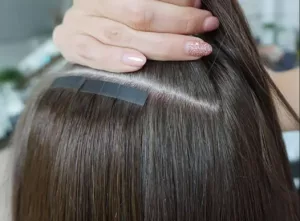
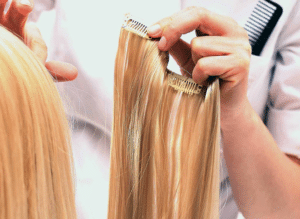
Have U ever seen this question online and feel unsure what the person really means? Some people ask about cutting the tape piece itself. Others ask about cutting the tape-in hair for shape. The same sentence can point to two different things.
Yes, both can be cut, but the “rules” are different. Also, most standard tape sizes on the market do not need cutting at all. Those widths exist for a reason. They have been tested by salons for years. Cutting is mainly for special placement needs or a client with unusual density zones.

Below is a clear answer to both meanings, plus what to watch for so salons avoid early lifting and thin results.
Can you cut tape in hair extensions?
Have U heard someone answer “Yes” without asking which part? That is where confusion starts, and that is why people get mixed results.
Yes, U can cut tape in hair extensions in two ways:
1) U can cut the tape piece (the adhesive tape used on the tab).
2) U can cut the tape-in hair extensions (the hair for length, layers, and blending).
The warnings are not the same for each one.
Most of the time, standard tape sizes do not need cutting. The common widths sold by professional suppliers are already a proven balance of hold, comfort, and invisibility. A salon usually cuts only when the placement zone is narrow, or when a client needs a more customized fit.
Dive deeper
A tape-in extension has a bonding zone and a hair zone. The bonding zone relies on contact area and clean adhesion. The hair zone relies on density and shape. When the question is not specific, the answer should cover both.
If the question means “Can U cut the tape piece itself?”
This usually happens during re-tape, custom width work, or small placement zones.
In the real market, standard tape widths exist because they work for most clients. A standard width gives enough bonding surface to resist oils, sweat, and daily movement. It also spreads tension across the natural hair section. That balance is why many salons do not cut tape strips for normal installs.
Cutting tape becomes useful only in certain cases:
- temple area or hairline placement zones that are narrow
- very fine density clients where a smaller tab fits better
- custom spacing plans for special head shapes
- repair work where a stylist needs a smaller piece for a partial tab
Even in those cases, the tape should not be cut “as small as possible.” A smaller surface can reduce hold. It can lift earlier. It can also create edge peel, because small corners catch lint.
Key cautions for cutting tape:
- The tape strip should match the tab size, not smaller “just because.”
- Edges should be straight and clean, because rough edges peel.
- Tape should stay dry and clean, because contamination lowers tack.
- Tape fragments should not be left in the hair.
If the question means “Can U cut the tape-in hair extensions?”
This is the haircut side. Cutting extension hair is common because clients want a certain shape. A correct cut improves blending. A wrong cut can expose the tape rows.
Key cautions for cutting the hair:
- Cutting should stay below the tape line.
- Thinning near the top can make tabs visible.
- Ends should stay full to keep a luxury look.
| What the person may mean | Short answer | Main risk | Main “watch out” |
|---|---|---|---|
| cut the tape piece | yes, but usually not needed | weaker hold | do not cut too small |
| cut the extension hair | yes, very common | visible tapes | do not thin near tapes |

How to cut tape in hair extensions?
Have U ever watched a stylist cut tape-ins and wonder why some sets last longer and look better? The difference is usually that the stylist knows what is being cut and uses the right rule set.
If U are cutting the tape piece, the goal is correct size and strong contact. If U are cutting the extension hair, the goal is blend and shape while protecting coverage near the tapes.
Dive deeper
This section gives a safe approach for each meaning of the question.
A) How to cut the tape piece (adhesive tape) safely
This is about fit and adhesion.
1) Measure the tab width first
A tape strip should match the tab. A strip that is smaller reduces bonding surface.
2) Cut in one clean line
A clean edge stays flat. A jagged edge tends to lift.
3) Avoid tiny corners
Tiny corners peel faster. A straight edge or a soft rounded corner lasts better in daily wear.
4) Keep tape clean
Tape should not touch remover oil, conditioner, or wet hands. Contamination lowers tack.
5) Use cutting only when needed
Standard tape sizes are already a strong choice for most heads. Cutting is a tool for special zones, not a default habit.
B) How to cut tape-in hair extensions (the hair) safely
This is about haircut finish.
1) Cut after installation
Installed hair shows the real fall and the real blend line.
2) Set the perimeter first
Choose the bottom shape. A soft blunt or U shape often keeps fullness.
3) Blend the shelf line lower
The shelf line often sits in the mid-lengths. Blending should happen there, not near the tabs.
4) Use controlled texturizing
Point cutting is safer than heavy thinning. Thinning near the top can expose tapes.
5) Keep the ends dense
Tape-ins look premium when ends stay full. Over-cutting removes that value.
| Cutting target | Best tool | Where to cut | What to avoid |
|---|---|---|---|
| tape piece | small sharp scissors | off the head, clean surface | cutting too small, jagged edges |
| extension hair | haircut shears | mid-lengths and ends | thinning close to tape line |
Is it better to cut hair extensions wet or dry?
Have U noticed how many cut problems show up only after blow-dry? That is why this question matters.
For cutting the tape-in hair extensions (the hair), dry cutting is usually better because it shows true length and blend. For cutting the tape piece, it should always be handled dry and clean because moisture and oils reduce adhesion.
Dive deeper
This question also changes depending on the meaning.
If the person means cutting the extension hair
Dry cutting gives the most accurate result.
- Dry hair shows real density.
- Dry hair shows where the blend line is visible.
- Dry hair shows if one side sits longer.
Wet cutting can stretch hair. When hair dries, it can bounce up. That can lead to over-cutting. A salon can still do a light outline cut on slightly damp hair, but the final blend should be done dry.
If the person means cutting the tape piece
Wet does not apply. Tape should be dry. Oil and water reduce tack. A salon should treat tape handling like clean prep work.
| Meaning | Best condition | Why |
|---|---|---|
| cut extension hair | dry | best accuracy for blend |
| cut tape piece | dry and clean | best adhesion strength |
What can go wrong after cutting, and how can U avoid it?
Have U seen a set that looks great on day one, then starts lifting earlier than expected? Sometimes the tape was cut too small. Sometimes the cut removed too much coverage near the top.
The main risks are weaker hold from cutting tape too small, and more visibility from over-thinning the top layers. Both risks are preventable when the cutting goal is clear.
Dive deeper
A salon should link each risk to its root cause.
Risk 1: tape lifts early
Common causes:
- tape strip cut smaller than the tab
- jagged edges that peel
- tape touched remover oil or wet hands
- tape area touched conditioner during wash
Prevention:
- match tape width to tab width
- keep edges clean
- keep tape dry and clean
Risk 2: tabs show more after haircut
Common causes:
- layers started too high
- thinning shears used near the top
- top coverage became too light
Prevention:
- keep blending lower
- keep top density strong
- cross-check visibility after cutting
Risk 3: ends look thin
Common causes:
- too much thinning
- aggressive texturizing
- sharp V shape on clients who want fullness
Prevention:
- keep ends dense
- use point cutting for softness
- choose a shape that fits the client goal
| Outcome | Most likely reason | Best prevention |
|---|---|---|
| early lift | tape cut too small | keep full contact area |
| visible tapes | over-thinned top | protect coverage |
| stringy ends | over-texturizing | keep density at ends |
How should salons explain this to clients asking online?
Have U seen clients repeat internet terms like “cut the tape”? Some clients mean the adhesive. Some clients mean the hair. A salon should answer in one sentence, then ask one quick follow-up.
A clear salon answer can be:
“Yes, both can be cut. Do U mean cutting the adhesive tape piece, or cutting the extension hair for shape?”
Dive deeper
This is practical for salons and for wholesalers who support salon customers.
A client who cuts tape pieces too small may experience early lifting. That leads to complaints, extra maintenance, and a bad impression of the method. A client who cuts hair too high may expose tabs and blame the product. A short clarification saves time and protects the method.
A salon can also teach two simple rules:
- Tape work is about surface area and cleanliness.
- Hair cutting is about blend and keeping the top strong.
This kind of explanation builds trust because it sounds specific and real. It also helps clients feel guided before they spend more money.

My opinion
This question works best when the answer covers both meanings. Standard tape widths do not need cutting in most cases. Cutting is useful only when placement zones or client needs make it necessary.
FAQ
Can U cut tape-in hair shorter after installation?
Yes. Cutting after installation is normal for blending. The cut should stay below the tape line.
Can U cut the replacement tape smaller to make it “more invisible”?
A smaller tape strip can reduce hold. A strip should match tab size unless a stylist accepts shorter wear time and higher maintenance.
Does cutting tape-in hair extensions make them shed more?
Cutting the hair does not cause shedding by itself. Cutting into the tab base or damaging the tab can cause shedding.
Should U cut tape-in hair wet?
Final blending is best done dry for accuracy. Wet cutting can lead to over-cutting.
Can thinning shears be used on tape-ins?
They can, but they should stay away from the tape line and top coverage zone.
Conclusion
Both the tape piece and the tape-in hair can be cut. Standard sizes usually do not need trimming, and customization should protect bond size and top coverage.